Table of contents
How to Improve AI Visibility: 17 Proven Strategies to Get Recommended by ChatGPT, Gemini, Perplexity & Claude

About a month ago, we spoke with a marketing manager who noticed something strange about her business. Her rankings had not changed, her traffic was steady, but her leads had dropped.
And when she looked closer, she found the reason behind it.
Now people were asking ChatGPT, “Who’s the best branding company for a D2C skincare brand?” And in response to this ChatGPT mentioned three agencies.
Her agency wasn’t one of them.
Well that’s the gap no one prepared us for.
Today you can rank #1 on Google and still be invisible the moment someone pulls up an AI tool and ask it for a recommendation instead of a list of links. It’s a different way of finding information, with different rules.
A lot of what’s called “AI SEO” is simply old SEO advice with a new name. Or it’s filled with big ideas but very little practical guidance.
So understand what really works?
First, an honest point: nobody including us can guarantee that your business will be mentioned by ChatGPT. AI models change all the time.
Now to get cited what you can do is you can improve the signals that help AI understand your business and trust it as a good recommendation.
Here are the things that matter most.
Simply explained: what is AI visibility?
In simple words the term AI visibility means whether you brand gets mentioned – accurately by its name at the time when someone asks an AI tool like ChatGPT, Gemini, Perplexity or Claude and ask them for a recommendation, in your space.
- SEO is the optimization that gets your page ranked high in Google.
- AEO (Answer Engine Optimization) refers to the optimization process that pulls your content into direct answers and featured snippets.
- GEO (Generative Engine Optimization) is the means by which your brand is mentioned in an AI chat without any clue to a specific page.
All three do overlap, but each one has different priorities and GEO is the one most brands really haven’t touched yet.
The AI Visibility Pyramid
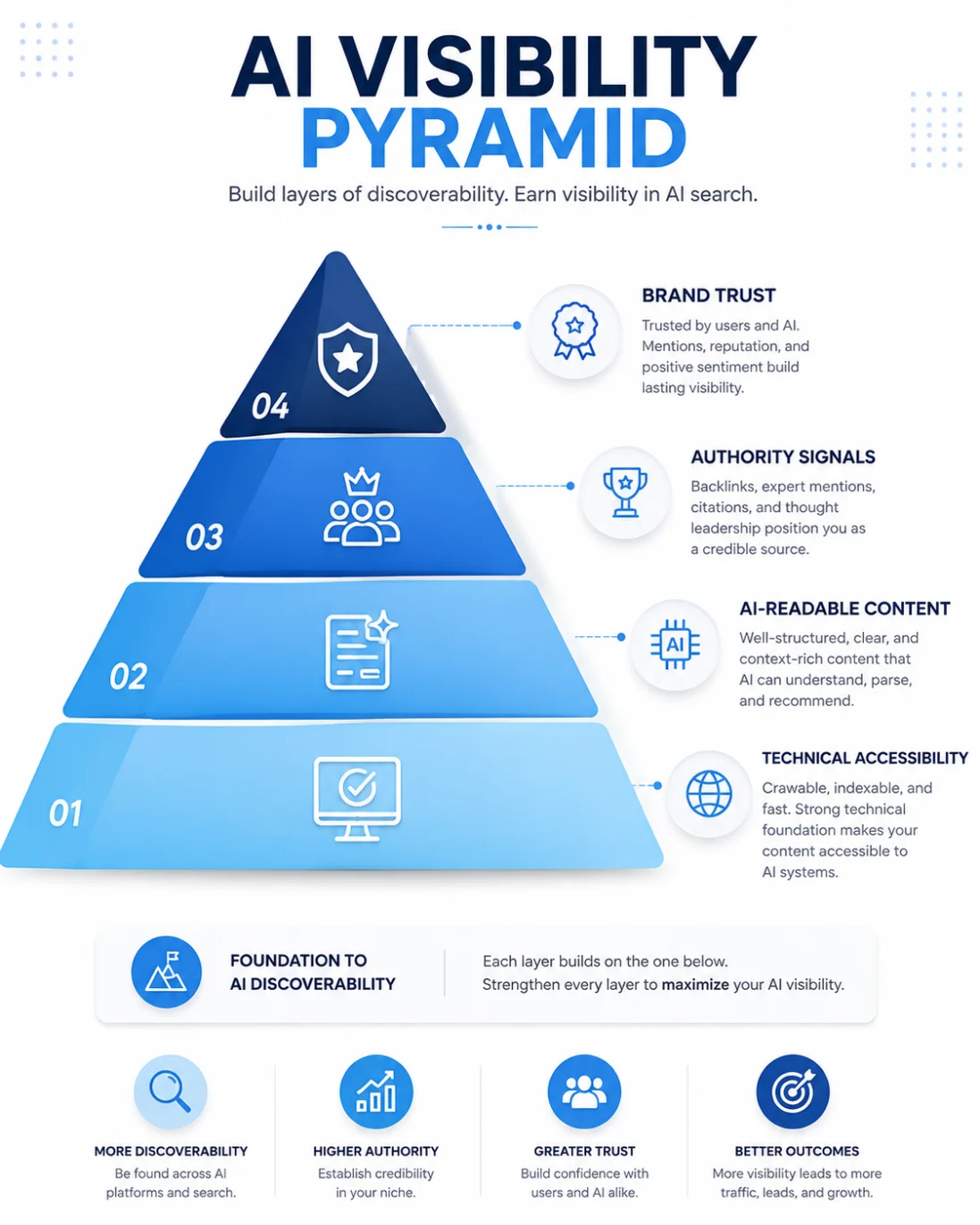
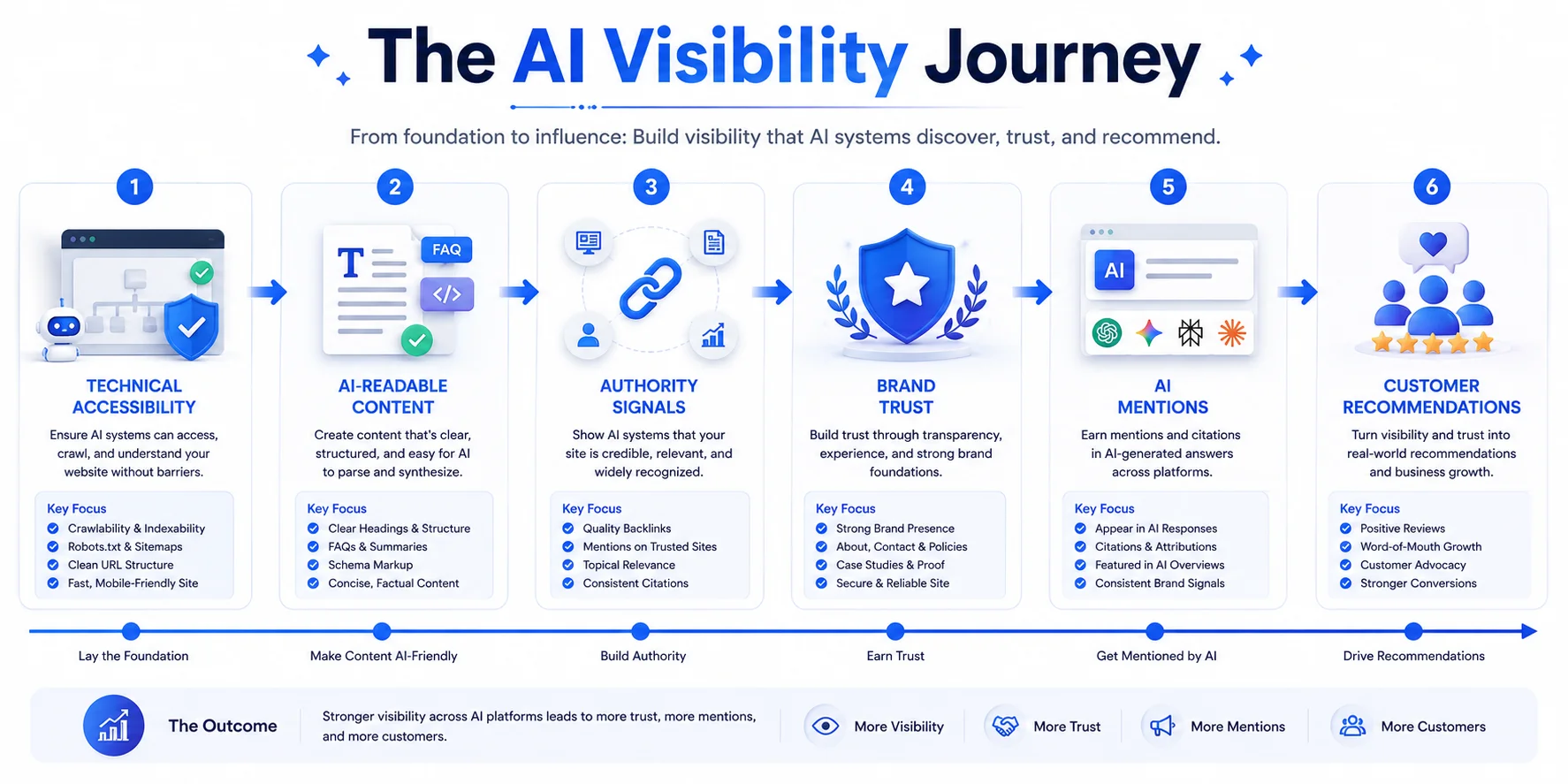
Now think of AI visibility as four layers that are stacked on top of each other. And each one matters only if the layer below it is solid:
- Technical Accessibility — can AI crawlers even reach your site or is your system blocking them quietly?
- AI-Readable Content — can an AI model pull a clean answer easily from your page without getting lost in noise or cluttered?
- Authority Signals — do other trusted sources confirms the things that you are mentioning on your site or you are just speaking in void?
- Brand Trust — does the broader internet speak of you in such way to inspire the model to process the information about your brand?
Most of the businesses are busy with the construction of the bottom two levels of the pyramid, because these are the only ones that are fully under their control. And the top two levels are the ones where you create visibility for AI, and almost nobody think about investing in it on purpose. It’s interesting to think about it for a moment – the levels over which you have the least control over your website work the best.
Layer 1: Technical Accessibility
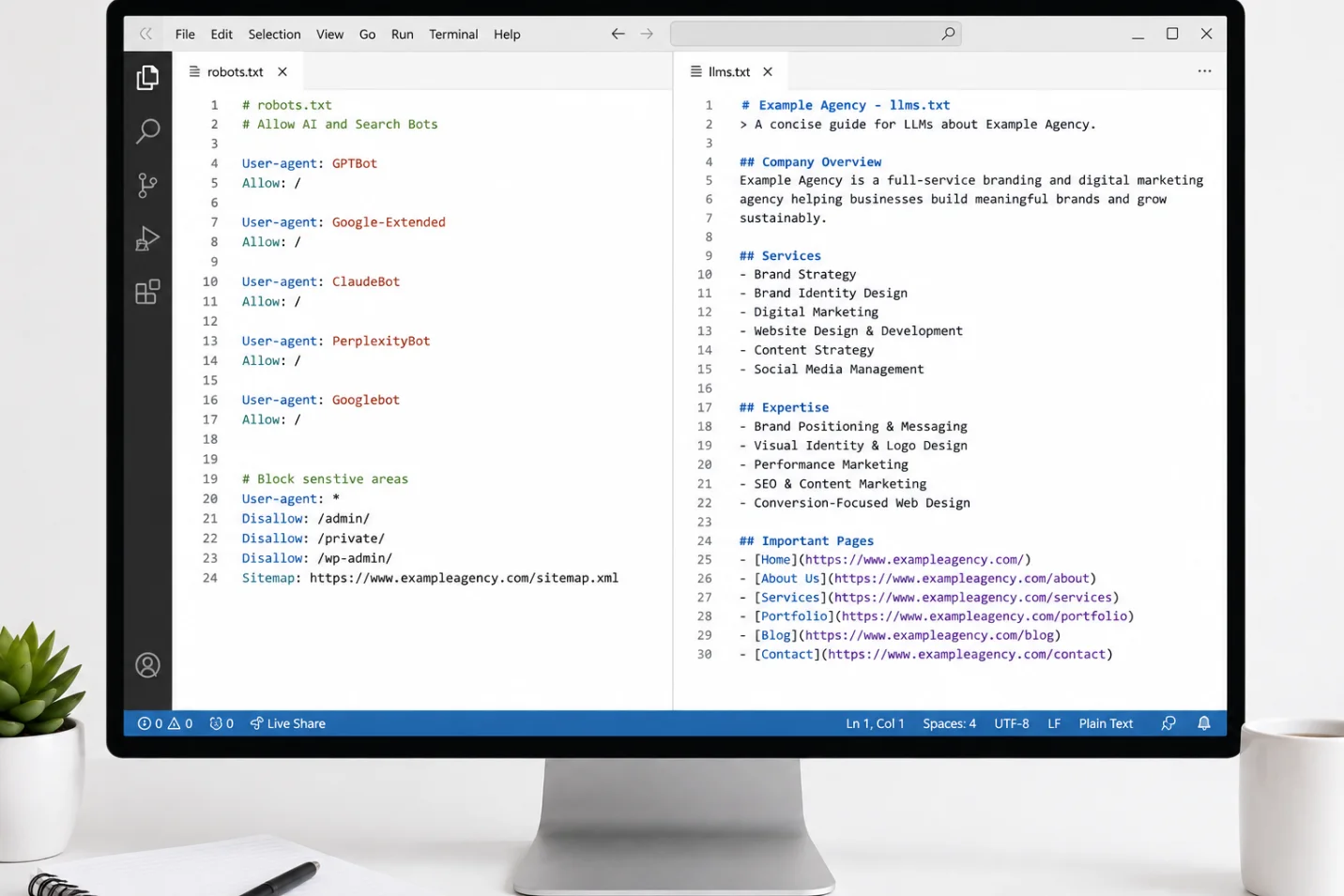
- Make sure that AI crawlers can reach your site: Start by checking your robots.txt file and make sure that you have not blocked bots from ChatGPT, Gemini, Perplexity, Claude and Google-Extended. It is one of the most common issue found on the older websites.
- Add an txt file: An llms.txt file is the one that gives AI systems a simple summary of your whole website. While support is still growing, but it is quick to set up and can help AI better understand your content.
- Keep your website fast and easy to read: AI crawlers work best with clean, fast websites. Improve your page’s speed, use simple HTML where possible and avoid heavy java script.
Layer 2: AI-Readable Content
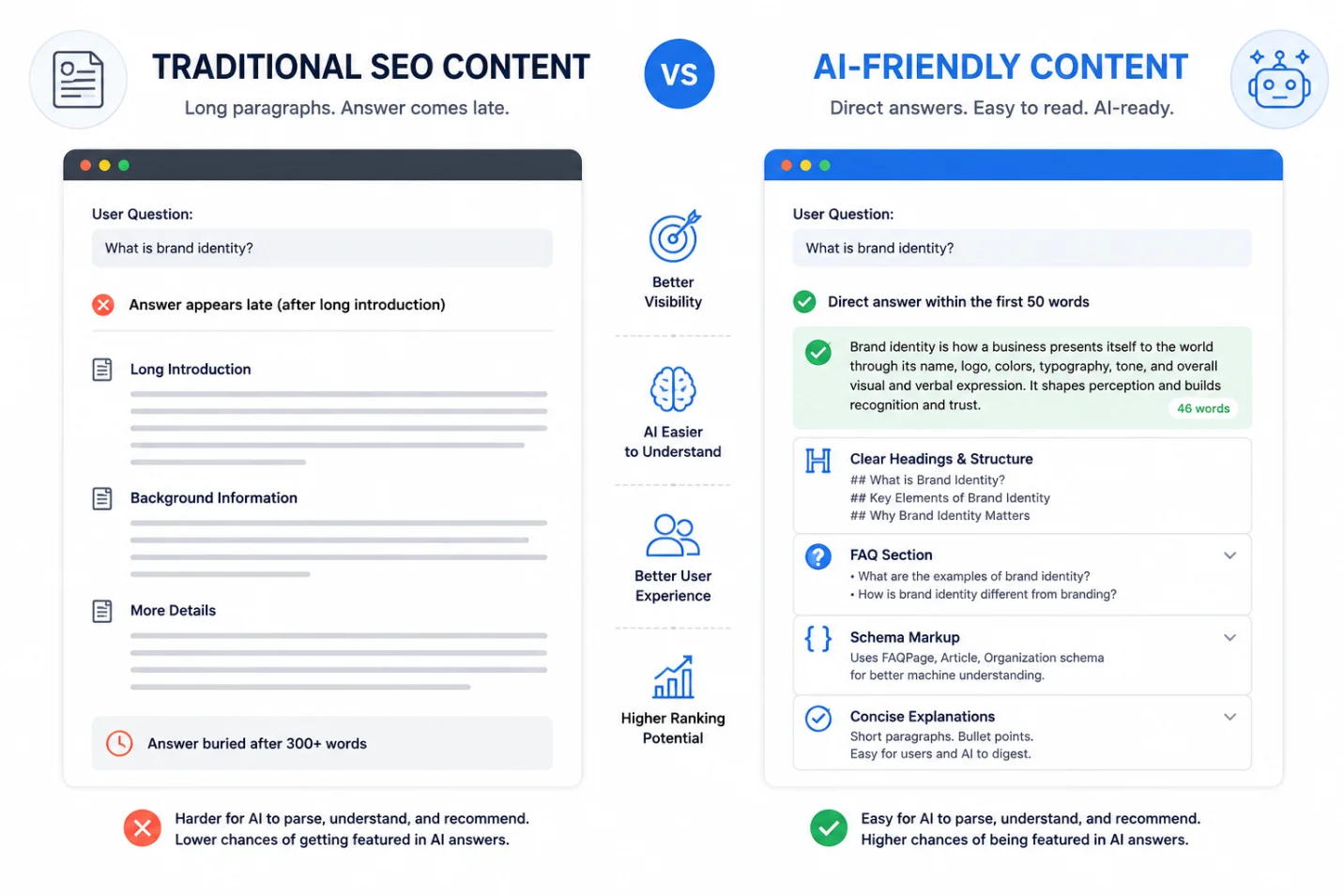
- Answer the question in the first 40–60 words. Give answer in the first 40-60 words and then explain the details. This will make it easier for both readers & AI tools to understand your content clearly.
- Structure content around real questions, not keywords. People don’t think in keywords – our own checklist for why blogs don’t rank still performs well because it was written around a real question.
- Use a Q&A format where it’s genuinely natural. Not every heading needs to be a question – Don’t force every section into a Q&A format just present that in a way how a real person would actually ask.
- Add schema markup. Adding a schema for Article, FAQ & Organization will help machines to understand what your page actually is.
- Keep content genuinely fresh. Review your pages time to time – stale content quietly stops getting cited.
Layer 3: Authority Signals
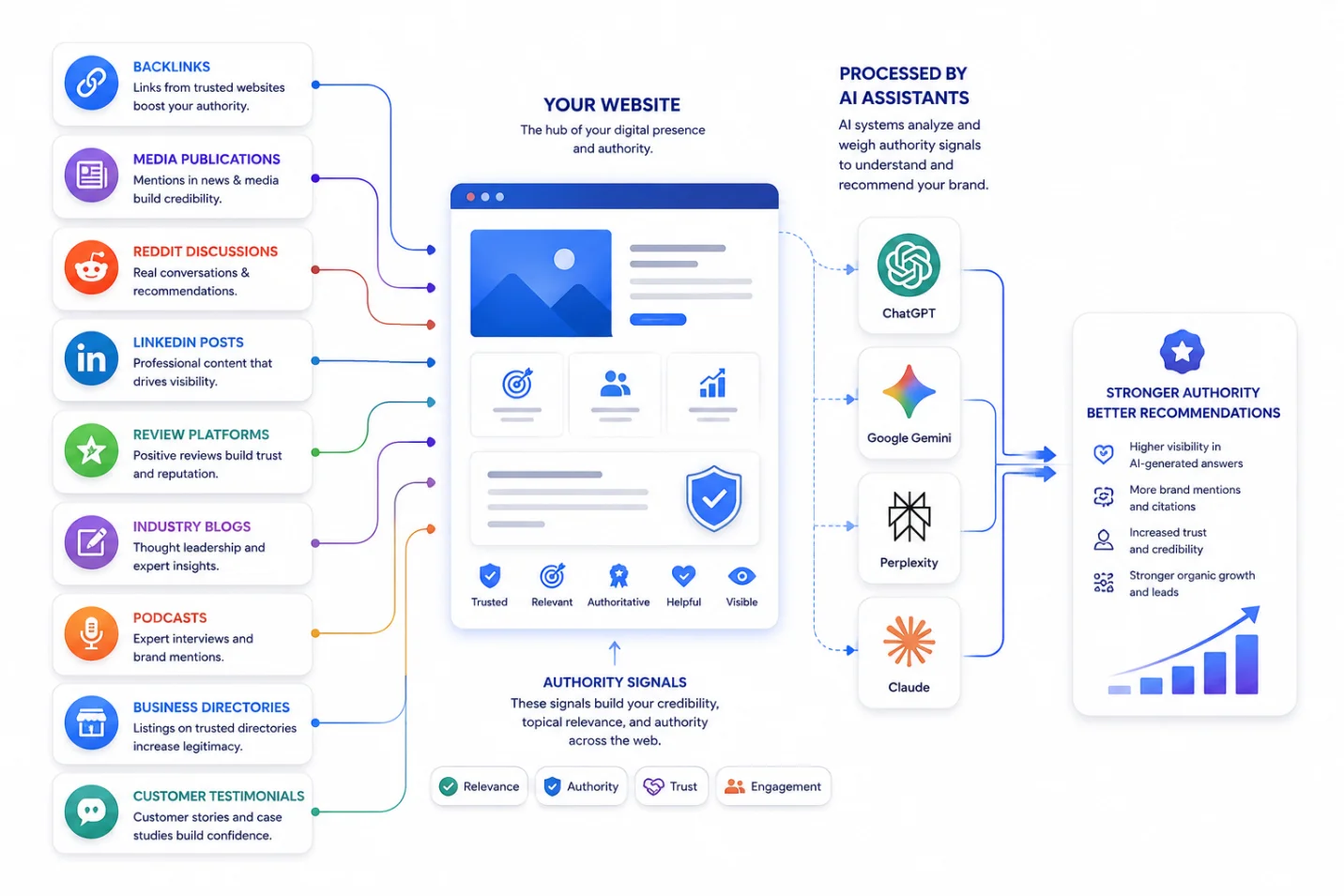
- Gain mentions on sites that the AI models trust. Industry magazines, reviews & roundups written by an external source are more trusted than anything you say about your company because the model has no way to verify the claims you make for yourself, but it does consider the frequency of the mention in the external source.
- Earn quality backlinks. Focus on earning backlinks from trusted websites through digital PR, media coverage or through original research. Avoid buying links from link farms, as they can do more harm than good.
- Publish something worth citing. An analysis of AI citation patterns found that the content presented in listicle-style earns over a quarter of all AI citations, it is biggest share if any format (source). The same research tracked roughly 900 new pages and found a median of under seven days to the first citation, with 90% cited within 37 days. So if your page which you published about a month ago still has not been picked up anywhere, do a quick technical check first before considering it as failed.
And hey, one more thing which is worth mentioning here: as models get better at reasoning about brands as “entities” rather than just web pages, being clearly and consistently described everywhere online becomes its own little advantage. That’s a deeper topic than we can fully unpack here… think of it as the next thing to explore once the basics above are already solid.
Layer 4: Brand Trust
- Show up where real conversations happen. Reddit, Quora, LinkedIn comments. Off-site conversations like these shape a surprisingly large share of what AI models say about a brand – more than most brands realize (source).
- Keep your business info consistent everywhere. Name, address, phone, and description — across Google Business Profile, LinkedIn, directories, and your own site.
- Put a real person behind the content. A name and real credentials, not “our team of experts.”
- Show real outcomes, not vague testimonials. The testimonials that land hardest on our own site name what actually changed – like Global Solicitors mentioning a decade-long partnership, or Sikh Accessories going from a regional name to a global one.
- Make sure your claims hold up everywhere. If your about page and your LinkedIn tell slightly different stories, that inconsistency quietly costs you trust.
- Answer the deeper question. Not “how do I optimize my website,” but “how does an AI model build enough confidence to recommend me by name?” That’s brand trust, built over time — not a content sprint.
Where most brands quietly go wrong
A few patterns show up constantly once you start looking, and none of them are hard to fix once you know to check for them.
- Keyword-stuffing dressed up as “answering the question.” A model trained on millions of genuine explanations can tell the difference between a real answer and one padded with repeated phrases — and so can your reader.
- Blocking the exact crawlers you’re trying to court. Covered above, but common enough to repeat: check your robots.txt before you do anything else on this list.
- Pure aggregation with no real point of view. Summarizing what five other articles already said, with nothing original added, might have worked for search rankings years ago. It gives a model nothing worth citing you specifically for.
- Obsessing over your own website while ignoring everywhere else. This is the big one. Most of what shapes an AI model’s opinion of you happens off your domain, and most content strategies still spend nearly all their budget on it.
A quick note on each platform
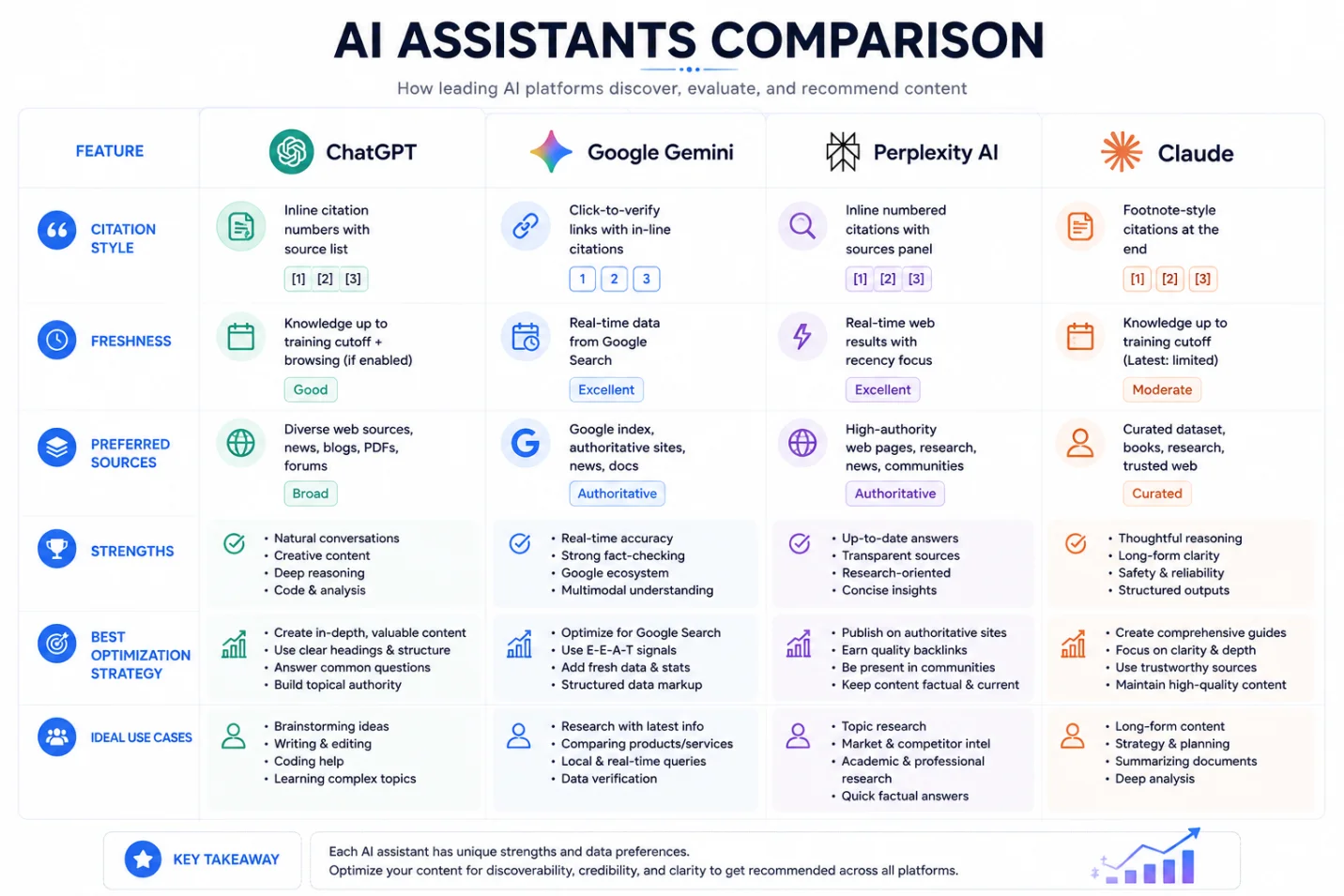
Different search engines function differently, and hence it is important to put in efforts in the right way after identifying the search language your customers are actually practicing.
- ChatGPT works with a combination of trained information and incoming information. The search engine also emphasizes reliable sources that are clearly referenced on many sites.
- Among all, Perplexity is evidently the most citation-based engine. It shows its references directly in the answer and is also quick in indexing the new information when compared with the others.
- Gemini works in the wider frame of Google so that the conventional signals of the technical SEO, such as structured data, Search Console, and others, are more useful in working with this engine than in dealing with the other ones.
- Claude is aimed at the reliable and trustable sources regardless of the formatting.
Test this yourself, monthly
Pick five real prompts a buyer would actually type, you know, specific like a bit awkward, not “best branding agency.” Then run them through ChatGPT Perplexity Gemini, and Claude. See if you’re mentioned, cited, or just absent and also who shows up instead. Do it every month and you’ll have a real log of how your category is shifting, instead of some vague guess.
If you want to track it at scale
Manual checking works to start, but it doesn’t scale past a handful of prompts. A few real tools now do this automatically: Otterly.AI is the accessible entry point, Peec AI covers the mid-market with deeper prompt tracking, Profound is built for enterprise-scale citation tracking, and Semrush’s AI Toolkit is worth a look if you’re already a Semrush customer. Pricing in this space moves fast — check current vendor sites before budgeting.
Score yourself before spending on any of it
| Category | Points | What it’s asking |
| Content structure & clarity | /20 | Do pages answer fast, in extractable form? |
| Authority & backlinks | /20 | Are you cited by sources you don’t control? |
| Schema & technical setup | /10 | Is your site legible to a crawler? |
| Reviews & third-party mentions | /10 | What does the web say about you? |
| Off-site presence | /20 | Do you exist in conversations, not just content? |
| Original research | /10 | Have you published anything worth citing? |
| Author credibility | /10 | Is there a real, credentialed human behind it? |
Quick Answers
The short version
Five years ago, success meant ranking first on Google. Today it also means being the brand an AI model recommends without hesitation, unprompted, when someone it’s talking to needs exactly what you offer. Rankings still drive clicks. Recommendations drive trust before the click even happens – and that’s worth building deliberately, layer by layer, instead of leaving it to chance.
If you’d rather have a team handle the technical setup, content restructuring, and the slower authority-building work while you run your business, that’s what our content marketing and SEO teams do every day. Get in touch whenever you’re ready.