Table of contents
- Answer Engine Optimization (AEO): How to Get Your Content Cited by AI Tools
- What Is Answer Engine Optimization (AEO)?
- Why This Matters More Than Most Marketers Think
- The Scale of AI Search in 2026
- SEO vs AEO: What Is Actually Different?
- Why Most AEO Advice Is Wrong (And What to Do Instead)
- The AEO Content Structure Model: 7 Layers That Get You Cited
- AEO in B2B: The Buying Cycle Has Already Changed
- Real-World Example: What AEO Optimization Actually Looks Like
- The Pre-Publish AEO Checklist (Updated for 2026
- The Real Competitive Advantage Is Being Early
Answer Engine Optimization (AEO): How to Get Your Content Cited by AI Tools
What Is Answer Engine Optimization (AEO)?
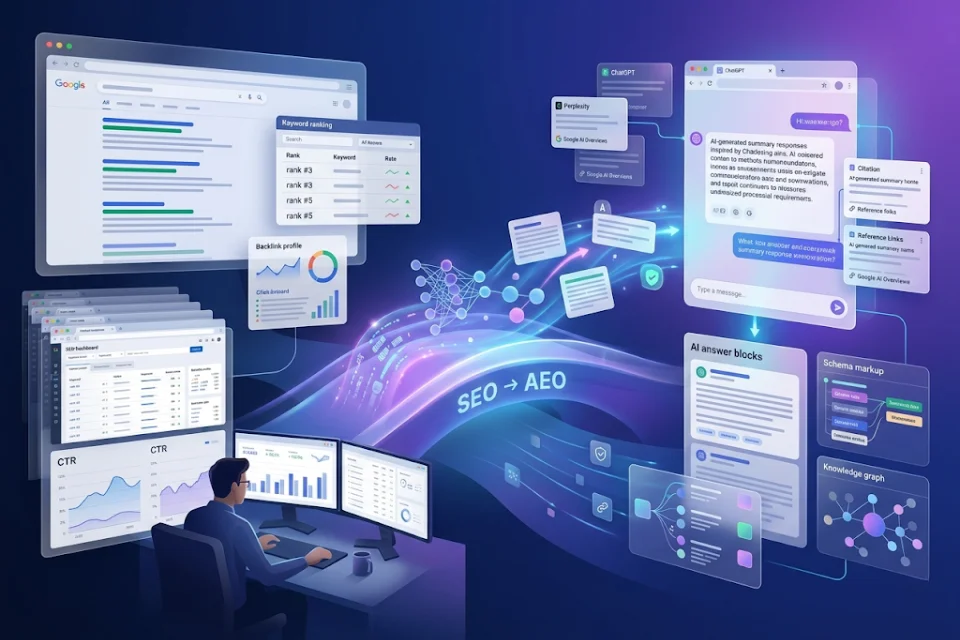
AEO or Answer Engine Optimization is the practice of structure out your content so that AI powered tools like Google’s AI overviews, ChatGpt, Perplexity & more can extract the right information, summarize the content & cite it directly in their responses to the user’s queries.
Unlike the traditional SEO methods, whose aim is to rank your page in a list of results on Google, AEO aims to make your content the answer itself. For this the main goal is not get clicks – it is to get citation.
If your content is not structured well for extraction, it does not matter then how well it ranks. AI tools will simply skip it and cite someone else even if their content is not good as yours.
Why This Matters More Than Most Marketers Think
Well there is a quiet shift that is happening in how people find information online & most of the businesses have not caught up with it yet.
Now whenever someone types a question into Google today, they often get the answer right there on the page. No clicking on mutliple sites and no scrolling through ten blue links. Just an AI-generated response pulling answers from sources it trusts the most.
That is the new battlefield. And most brands are not even on it.
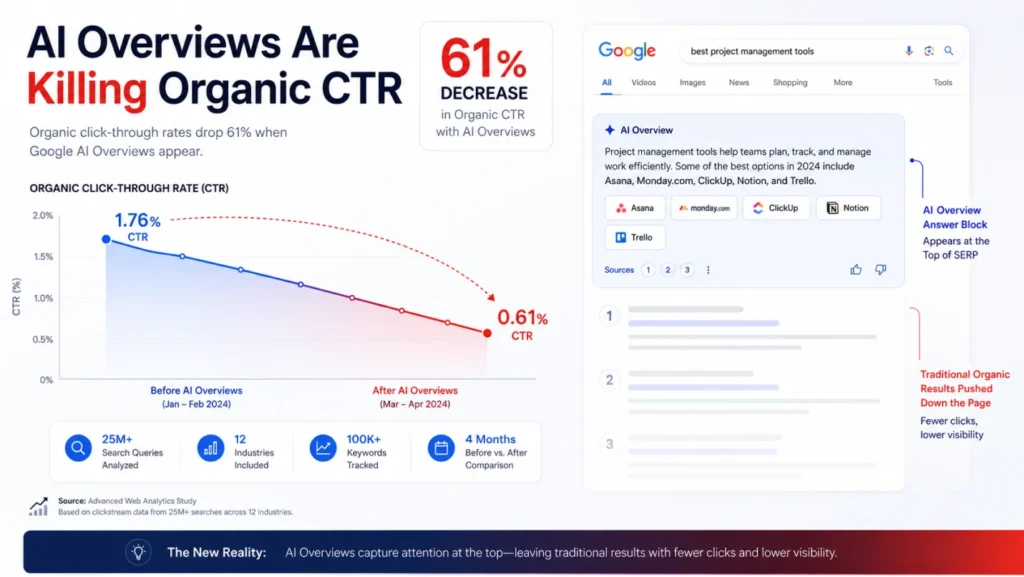
Approximately 40% – 60% of U.S. information searches display Google’s AI Overviews (BrightEdge, 2026). Whenever AI Overviews show up, organic CTR is drastically reduced. In one such study, widely cited from 2026, the click-through rate dropped from 1.76% to 0.61% when an AI block was placed above the organic search engine results — a 61% decrease in CTR for organic listings.
In addition, in this same study, there was a significant reduction in paid search click-through-rates: 19.7% – 6.34% drop for paid listings.
The search traffic that decreased due to the presence of the AI Answer Block didn’t go to another competing business, but remained within the Google search engine page within the AI Answer Block(s).
Brands that were cited in the AI Answer Block were provided free visibility and brands not cited in the AI Answer Block lost the visibility of free clicks they had been receiving.
The Scale of AI Search in 2026
Before diving deep into the tactics, lets take a look that how big AI search has become in 2026.
- ChatGPT alone now handles around 12% of Google’s search volume, this makes it roughly around 250 – 500 million queries every single week.
- Perplexity sees 30+ million searches daily, all of these queries are mostly from the people looking for direct answers.
- About 35 – 45% of Fortune 1000 companies are already investing in AEO or asking agencies for it.
- The market of AEO tools is now worth $1.2–$2 billion and it is growing fast every year.
- Research shows that most B2B buying journeys now start with AI, with many people involved – and many of them using AI to research options.
These aren’t small or experimental trends. AEO is already becoming standard for companies that want to stay competitive.
SEO vs AEO: What Is Actually Different?
| Factor | Traditional SEO | Answer Engine Optimization (AEO) |
| Goal | Rank in search results | Get cited inside AI answers |
| Audience | Google’s ranking algorithm | AI extraction systems |
| Success metric | Rankings, organic traffic | Citation rate, share of model |
| Content format | Keyword-optimized pages | Modular, extractable answer units |
| Authority signals | Backlinks, domain authority | Third-party mentions, trust signals |
| Structure priority | Internal linking, meta tags | Schema markup, entity clarity |
| Click dependency | High — ranking means clicking | Low — citation happens without a click |
The honest truth: SEO and AEO are not competing disciplines. SEO builds the foundation — domain credibility, page authority, rankings — and AEO builds what sits on top of it. A page that is strong at both is the most defensible asset in search today.
Strong search engine optimization is not a parallel track to AEO. It is often a prerequisite.
Why Most AEO Advice Is Wrong (And What to Do Instead)
Well here is the part that most of the guides skip.
Most AEO advice that the content should have clear headings, short answers, bullet points – well this is not wrong. But it’s incomplete & on its own it won’t get you cited.
To think of AEO as formatting issue is incorrect because it is a trust issue (architecture of trust). Formatting assumes that AI cannot read your content. Trust means AI can read it, but doesn’t trust it enough to cite it. No amount of structure fixes that.
AI does more than just organize content; it also cross-references content. When you make a claim, AI verifies against other sources, such as Wikipedia, trade journals, reviews, and third-party sources. If your content demonstrates a low or varied amount of validation, it will lose its rank in search results, regardless of how well structured the content is.
That’s why perfectly structured pages often go uncited, while less polished ones with strong external validation get pulled into AI answers. Trust outweighs formatting almost every time.
The brands winning AEO in 2026 do both: clear structure & strong external credibility. That combination is the foundation of this framework – and what comes next.
The AEO Content Structure Model: 7 Layers That Get You Cited
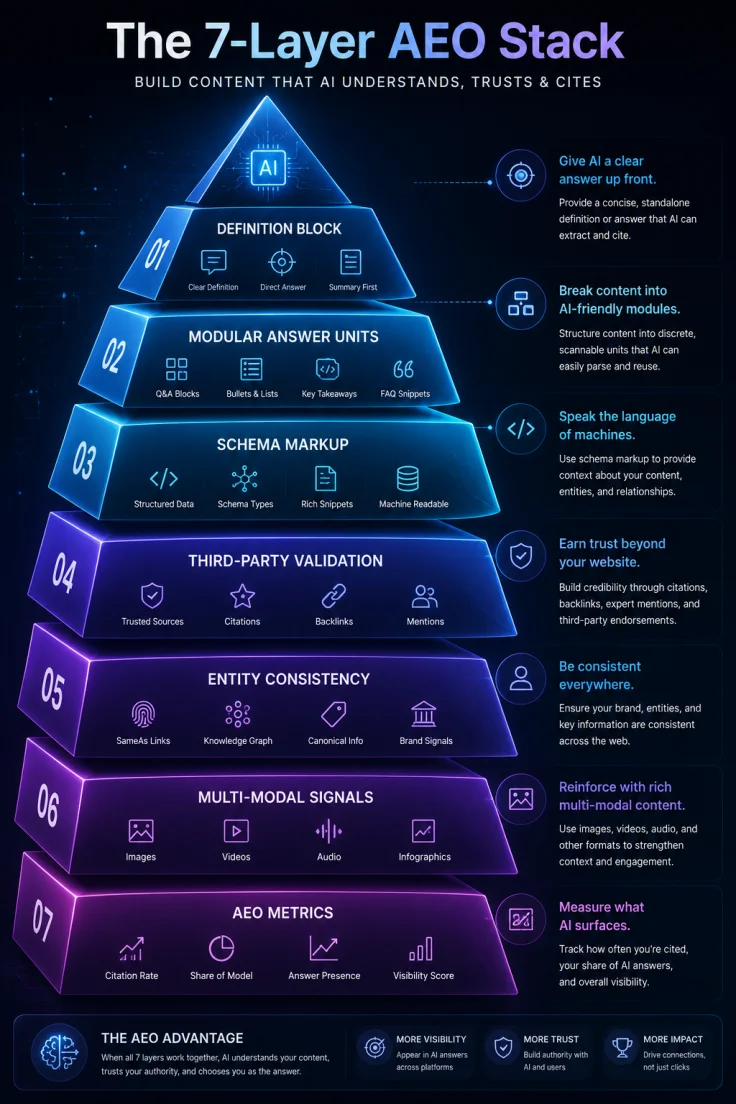
Think of AEO not as a checklist but as a stack. Each layer adds to your citability. Weak layers reduce it.
Layer 1: The Definition Block (Non-Negotiable)
Every page targeting a key concept needs a clean, standalone definition block at the top — written so it can be lifted and used directly in an AI response.
This is not the same as an introduction. An introduction sets context. A definition block delivers the answer immediately, in a format the AI can extract without editing.
Format it like this:
[Topic] is [clear definition]. [One sentence of context or scope].
Example already at the top of this article. Every major page on your site should have one.
Layer 2: Modular Answer Units (Not Just Flowing Prose)
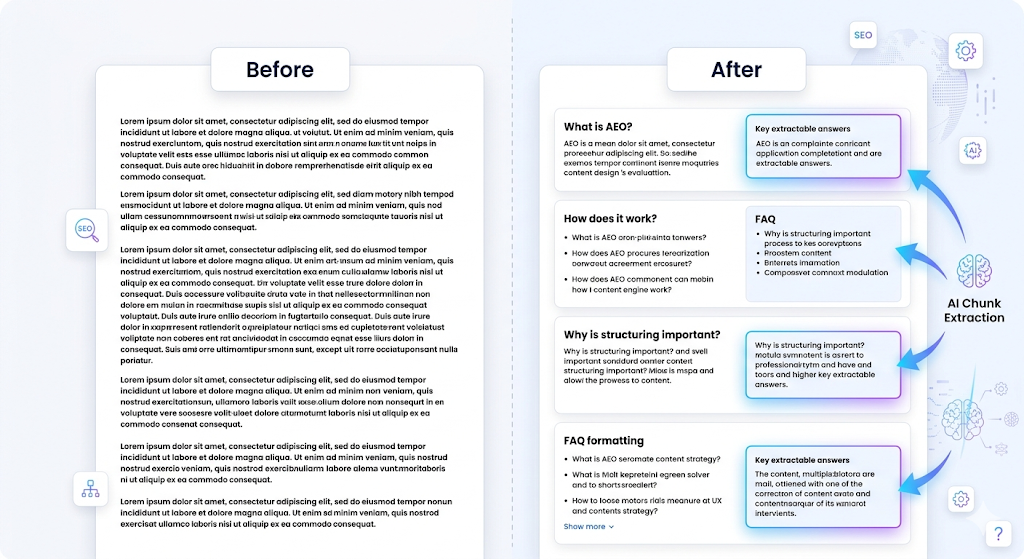
Flow-based writing reads well. Modular writing gets cited.
The difference: modular sections make sense when read in isolation. Each section answers exactly one question and does not depend on the section before it to be understood.
AI systems — especially those built on Retrieval-Augmented Generation (RAG) — ingest content in chunks. Research suggests the optimal chunk size for RAG ingestion is 200 to 400 words per section. Sections longer than that get split in unpredictable ways; sections shorter than that lack enough context to be useful.
Before (flow-based, harder to cite):
“Now that we have covered how AI tools work, it is worth thinking about how your content structure plays into this, because the relationship between what you write and how it gets parsed is more nuanced than most guides suggest.”|
After (modular, extractable):
How does content structure affect AI citation? AI tools parse content in chunks, not as full documents. A well-structured page breaks into 200–400 word sections, each answering a distinct question. This allows the AI to extract exactly the part it needs without misrepresenting the rest of the page.
Same information. Very different citability.
Layer 3: Schema Markup (The Technical Backbone)
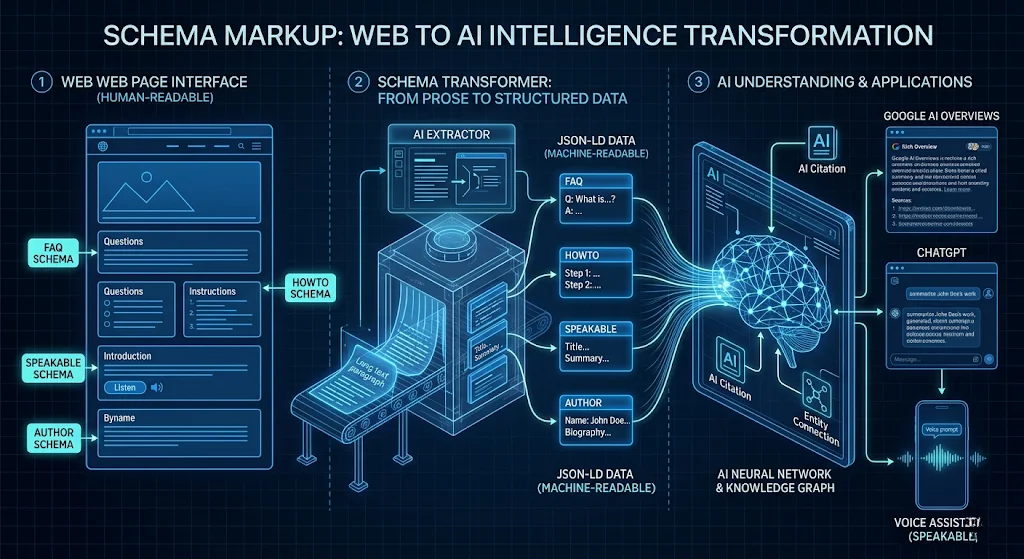
This is the layer most content teams ignore and this is the one costing them citations.
AI engines don’t just read visible text on site, they ingest structured metadata. To get citations it is important to add Schema markup (in JSON-LD, placed in your page’s <head>) as it tells AI what your content is, who wrote it & what it answers. Without it, AI has to guess which leads to wrong, missed or no citations.
The types of Schema that matter most in AEO:
FAQ Schema – Marks Q&A so that AI can extract answers directly; It is highly impactful for informational content.
HowTo Schema – Structures step-by-step processes; essential for procedural content.
Speakable Schema – Flags content for text-to-speech tools like Siri, Alexa & Gemini Live—key as voice search grows.
Author Schema – supports E-E-A-T by linking content to a verified, consistent author identity, improving trust and extraction.
One practical note: JSON-LD is the preferred format for all of the above mentioned Schema’s as it sits in the page head, does not interfere with visible content & is the format Google explicitly recommends.
Layer 4: Third-Party Validation (The Citation Multiplier)
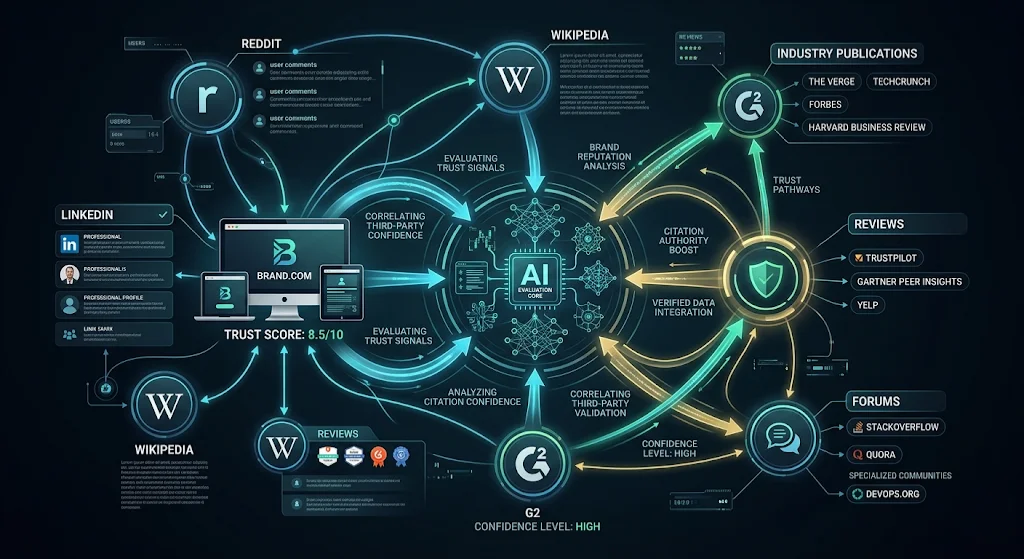
Here’s a number worth remembering: brands are 6.5× more likely to be cited by AI when mentioned by third-party sources rather than only on their own site.
AI systems use external mentions as validation anchors—checking whether your claims align with the broader web. If you position yourself as a category leader but lack mentions in publications, forums, or reviews, AI can’t verify it—and unverified claims get deprioritized.
What this means in practice:
Mentions on Reddit, G2, Capterra, industry forums, LinkedIn articles by credible voices, and niche publications all boost AI citability – not just SEO. Mentions on these sources acts as trusted external validators.
Wikipedia is the strongest signal. A well-sourced page is one of the highest-trust references for AI. If your company or key figures are notable enough, that presence should exist and be maintained.
This isn’t about gaming the system—it’s about building the real-world credibility AI is designed to reward.
Layer 5: Entity Consistency (Prevent the AI From Getting You Wrong)
AI systems understand the world through entities—defined things with consistent attributes. Your brand, products, and people are all entities, and AI builds their profiles from mentions across the web.
The problem: if your brand is described differently across your homepage, LinkedIn, About page, and press mentions, AI forms a confused profile—leading to weak or incorrect citations.
The solution is an Identity Block: a short, fixed description of your brand or product used consistently everywhere.
Example: “Brandlogg is a digital marketing agency specializing in SEO, performance marketing, and content strategy for growth-stage businesses.”
This same (or very close) sentence should appear across your homepage, Google Business Profile, LinkedIn, schema markup, and external bios. Consistency across touchpoints trains AI to represent you accurately.
Layer 6: Multi-Modal Content Signals
In 2026, AI tools aren’t just reading your text—they’re watching your videos and indexing your data.
Video AEO is emerging fast. Google’s AI Overviews now pull timestamped steps from YouTube videos into answers. If you create tutorials or explainers, your transcripts and chapter timestamps become citation-ready. Adding accurate transcripts and clear chapters puts your videos in the same citation pool as written content.
Dataset Schema is key for original research. If you publish surveys or proprietary data, marking it up signals to AI that your data is structured and citable—making it more likely your stats get quoted over competitors.
Layer 7: AEO-Specific Metrics (What to Actually Track)
Most teams still measure AEO with SEO metrics like rankings and traffic—but those say little about citation performance.
The metrics that matter:
Citation Rate — (Queries where your brand is cited ÷ total queries tested) × 100. Track manually using target queries across ChatGPT, Perplexity & Google AI Overviews.
Share of Model (SoM) — Out of 100 category queries, how often does AI mention your brand? This is the AI version of share of voice. For example, if someone asks “What’s the best [your category]?” in 100 variations, how often are you mentioned?
Brand Sentiment Delta — When you’re mentioned by any of the AI tools, is it accurate and positive—or outdated, incorrect, or neutral? Review this once in every three months and fix via your Identity Block and third-party content.
Appearance Rate — Separate from citation rate, this measures how often your content (not just your brand name) surfaces in AI responses as a reference or source.
These metrics do not yet have universal tracking tools. But running structured manual audits quarterly – testing 20 to 30 key queries across multiple AI platforms – gives you actionable directional data right now.
AEO in B2B: The Buying Cycle Has Already Changed
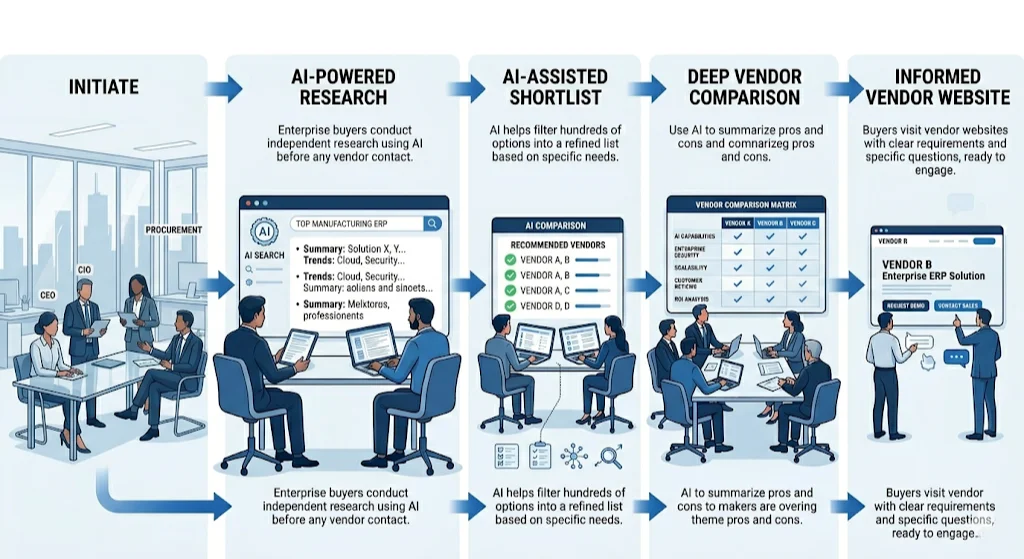
If you are marketing to business buyers, AEO deserves priority treatment — not eventually, but now.
Forrester’s 2026 B2B research is clear: generative AI is now the starting point for many business purchase evaluations. Buyers are using ChatGPT and Perplexity to shortlist vendors before they ever visit a website. The average enterprise buying decision involves 13 internal stakeholders and nine external influencers, many of whom are running their own AI-powered research sessions independently.
What this means: your brand can be eliminated from a shortlist before a salesperson ever sends an email. If the AI does not know you, or misrepresents you, or presents a competitor more confidently — you have already lost that conversation.
AEO is not a content strategy tactic for B2B. It is a revenue protection strategy
Real-World Example: What AEO Optimization Actually Looks Like
Theory is useful. A concrete example is better. Here is how a typical service page transforms when AEO principles are applied — and why the difference matters.
The page: A digital marketing agency’s “SEO Services” page.
Before AEO:
The page opened with generic copy about “today’s competitive digital landscape.” Headings were vague (“Our Approach,” “Why Choose Us”).
There was no clear definition of SEO, no FAQ, no schema markup, and inconsistent brand descriptions.
Result: when tested on ChatGPT and Perplexity, the page was never cited—nothing structured or authoritative for AI to extract.
After AEO:
The page opened with a clear definition of SEO and what services include. Headings became questions (“What does an SEO agency do?”, “How long does SEO take?”).
FAQ schema (JSON-LD) marked up Q&As, the brand description was standardized with an Identity Block, and third-party mentions were added.
Result: within a month, the definition was cited in Perplexity, and FAQs appeared in a Google AI Overview.
The takeaway:
The services didn’t change—only how the content was structured, defined, and validated. That packaging is what drives AEO.
The Pre-Publish AEO Checklist (Updated for 2026)
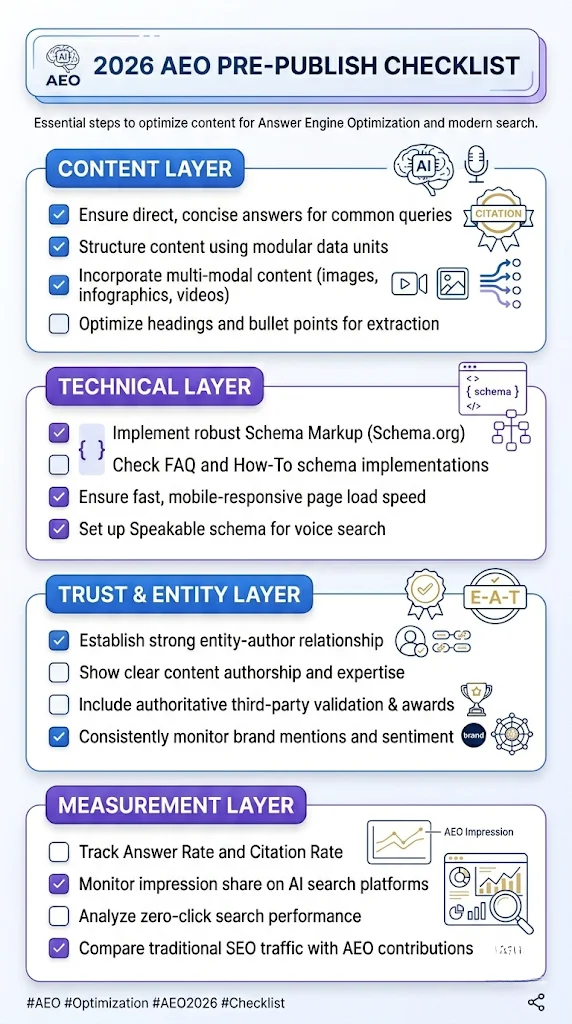
Before any strategic page goes live, It is important to work through this:
Content layer:
In Content layer it is important to keep check on these things.
- Does your content start with a clear & defined structure that can be cited word to word?
- Is every section has 200-400 words and makes sense alone?
- All claims are attributed to names sources?
- Does the page contain conversational Q&A sections?
- Does the headings match real user questions?
Technical layer:
In Technical layer it is important to keep check on these things.
- Does the page use JSON-LD schema markup (FAQ’s, HowTo, Article or Author)?
- Does speakable schema applies to the key answers?
- Is dataset schema applied to any original data or stats?
- Is the author entity is consistent across all the platforms?
Trust & entity layer:
In trust & entity layer it is important to keep check on these things.
- Is the brand definition is consistent everywhere like on homepage, schema, linkedIn & external sources?
- Does the content have at-least one third-party validation?
- Has the brand been mentioned in credible external sources in the topic area?
- Does any of your video have accurate transcripts & timestamps?
Measurement layer:
In measurement layer it is important to keep check on these things.
- Tests 20+ queries across ChatGPT, Perplexity, and Google AI Overviews
Tracks Share of Model monthly
The Real Competitive Advantage Is Being Early
Current market moves fast, but the majority of organizations still optimize for 2021 – working with keywords, but without structured data, without entity identity, without third-party validation and without modular page construction.
They create for search engines and AI processes data extraction.
There is still an opportunity to build citation authority, but the time left is limited, and each passing day brings us closer to the moment when AI will learn all that it needs based on existing indexing.
At that point, current citations will set a standard for citations in the future.
AEO is not a trend, it is a new SEO structure.
Begin with your important pages: add definition blocks, use FAQ schema, unify your entity identity and get at least one form of external validation (media mentions, reviews or forum mentions).
AI knows all about everything, but does it trust your content?
Create a good SEO base & only after that build your AEO. It is this mixture of structured data, trustworthiness, and external validation that makes you quoted