Table of contents
- Demand Generation vs. Lead Generation: Why the 'Lead Factory' Model Is Failing in 2026
- The Lead Factory Is Broken — and the Data Proves It
- Demand Generation vs. Lead Generation — The Clearest Explanation You Will Find
- Why the "Lead Factory" Model Is Collapsing in 2026
- The 2026 Buyer Journey Is Nonlinear, Self-Directed, and Largely Invisible
- Demand Generation Tactics That Actually Work in 2026
- Lead Generation in 2026 - What Still Works, and What to Kill
- How to Run Both Strategies Together Without Splitting Your Team in Two
- Which Should You Prioritise? A Decision Framework by Company Stage
- Conclusion - From Lead Factory to Revenue Ecosystem
Demand Generation vs. Lead Generation: Why the 'Lead Factory' Model Is Failing in 2026
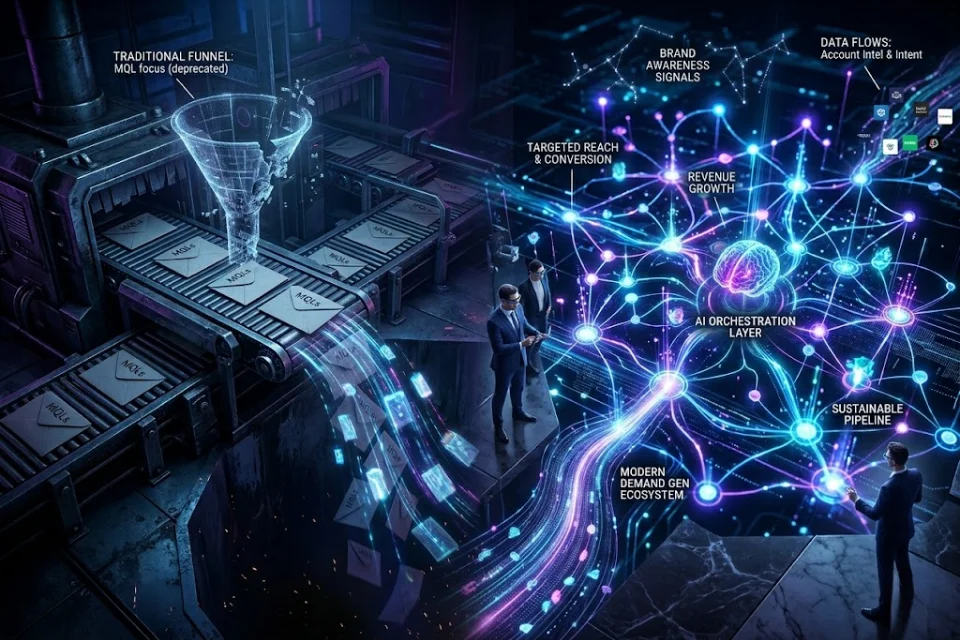
The Lead Factory Is Broken — and the Data Proves It
Let’s start this blog with an uncomfortable truth.
Most B2B marketing teams are running a machine that was designed for a world that no longer exists. Teams spend on gated content, track MQLs, pass lists to SDRs & call it pipeline. This is the lead factory model & it’s collapsing quietly.
The data we have is clear & tells a story. Over 60% of the software buyers prefer a brand before filling out a form. Nearly 70% of the modern B2B buyer’s journey happens anonymously – before your CRM even knows they existed. And yet most teams are still measuring success by the volume of contact records they capture each month.
Now this is not a tactic problem. It’s a model problem.
The lead factory assumes that buyers raise their hand early and wait to be nurtured and the truth is they don’t. What they do is they learn on their own – through mediums like communities, LinkedIn, reviews & AI models which answer their question without ever routing them to your landing page.
And here is the deeper irony: the harder you push for leads, the easier it is for buyers to ignore you.
The fix for this is not to abandon lead generation in fact it is to understand that where it fits within a much larger, much more important strategy: demand generation.
Demand Generation vs. Lead Generation — The Clearest Explanation You Will Find
Before we go further, let’s define this simply because most people mix these definitions with each other.
Demand generation is the work you do to create awareness in people. It helps them understand a problem, discover solutions & notice your brand notice your brand through a B2B brand strategy and planning services even before they are ready to buy. It’s long-term thing that builds trust over time & doesn’t always show immediate results.
Lead generation is the work you do to capture intent from people who are already in-market. It targets those who are already looking to buy & turns that interest into leads. It is a short-term & conversion focused and relies on the awareness that demand generation built.|
Here’s the simplest way to see it:
Demand generation builds the audience. Lead generation converts it.
| Demand Generation | Lead Generation | |
| Goal | Build awareness and trust | Capture intent and convert |
| Funnel stage | Top of funnel | Middle and bottom of funnel |
| Primary tactics | Content, thought leadership, community, social | Gated assets, paid search, demo requests, outbound |
| Key metrics | Brand search volume, pipeline velocity, share of voice | MQLs, form fills, cost per lead, SQLs |
| Buyer readiness | Not yet in market | Actively evaluating |
| Time horizon | Long-term (3–12+ months) | Short-term (days to weeks) |
Now just think of demand generation as growing a garden where you prepare the soil, plant seeds & water them consistently before any harvest is possible. And the lead generation is the harvest itself. You cannot skip straight to harvest and expect results.

Why the "Lead Factory" Model Is Collapsing in 2026
The Lead Factory model is not failing because marketers are doing it wrong. It is failing because the environment it was built for has fundamentally changed. Here are the five structural forces dismantling it in real time.
Signal 1 – Buyers are invisible until they are almost decided.
Most buyers complete ~70% of their journey before you know they exist. By the time they fill a form, they’ve already shortlisted vendors. Lead gen only sees the last mile.
Signal 2 – Gated content is losing the trust battle.
The old playbook – gate a white paper, capture an email – is wearing out. Buyers expect value upfront. The more you gate, the more you’re ignored.
Signal 3 – AI-powered zero-click search is absorbing top-of-funnel intent.
Buyers now get answers directly from AI – no clicks, no forms. If you’re not present where they learn, you won’t show up at all.

Signal 4 – Privacy regulations are raising the cost of the capture model.
Regulations like GDPR & CCPA are making list buying and data scraping harder—and riskier. “Buy and blast” is fading fast.
Signal 5 – Dark social is making lead gen look more effective than it is.
Buyers discover you through Slack, LinkedIn, or podcasts—then search for you later. Analytics credits search, but your content did the real work.
The 2026 Buyer Journey Is Nonlinear, Self-Directed, and Largely Invisible

The traditional funnel of TOFU, MOFU, BOFU – was always a vendor’s fiction. It reflects that how marketers wanted their buyers to behave, not how they actually do.
The journey of today’s modern B2B buyer isn’t linear. It’s messy and looks like a web. A buyer might find you in a LinkedIn comment, read your content over weeks, ask peers in Slack, check a competitor, revisit your site & finally request a demo. At no point did they identify themselves to your system until the very last step.
This creates two critical implications for your strategy.
- Demand creation vs. demand capture
Demand creation builds awareness and trust before intent appears. Demand capture converts demand that already exists. Most teams focus too much on capture and not enough on creation. - Buying committees matter
B2B deals involve 6–10 stakeholders. Lead gen only captures one person. Demand generation reaches the whole group through trusted content and channels—because you can’t close a deal if only one person knows about you.
Demand Generation Tactics That Actually Work in 2026
Well in demand generation the tactics that drove demand five years age – one-off awareness campaigns, sponsored white papers, trade show booths – are losing effectiveness now. And here are things that are working now.
- Always-on thought leadership, not episodic campaigns.
The brands that are winning in demand in 2026 are moving away from campaigns and instead of launching & running campaigns they build a media engine. This means high-impact content marketing through weekly podcasts, daily social presence & regular short-form videos.
The goal of this is “mental-visibility” – staying top-of-mind so when a buyer has a problem, you are their first call.
- Ungated content as the default:
Give your best thinking away for free. Put your research, your framework, your expert opinion out in the open. When people know & trust your brand and your content they willingly share the contact information for the right offer.
- Community-led demand
Your buyers hang out in Slack groups, LinkedIn communities, and niche forums. Join the conversation as a helpful expert—not a salesperson. It is one of the highest leverage demand generation activity available today & also it is one of the hardest to attribute, which is why most teams under-invest in it.
- Modern Metrics: Instead of counting leads, track:
- Brand Search Volume: Are more people searching for your name?
- Inbound Pipeline Velocity: How fast do inbound deals move compared to outbound?
- Share of Voice: How often is your brand mentioned in category conversations?
Lead Generation in 2026 - What Still Works, and What to Kill
Lead generation isn’t dead — it’s just changing. By using modern lead generation strategies, here’s what actually works today.

What still works:
- Target people showing intent:
Use first-party data which includes website visits and content consumption and product usage to identify accounts that are currently testing your solution.
- Use conversational AI:
Smart chatbots will take over lead qualification and real-time meeting scheduling to replace lengthy and difficult-to-use forms.
- Focus on high-value accounts:
Account-Based Marketing (ABM) allows you to contact the most likely customers who will close deals with your business.
- Offer real value upfront:
Tools which operate as ROI calculators or personalized assessments or interactive demos provide valuable content to users before they must share their contact information.
What to stop doing:
- Ten-field lead forms
- Cold, ungated PDFs
- Buying lead lists without clear consent
- Mass email blasts to stale databases
- Hiding basic thought leadership content behind a form
These old tactics might give you numbers, but they cost you trust, quality, and your sender reputation.
The new approach:
- Consent-first & preference-led: Don’t force people to give info. Earn it by providing value.
- Measure what matters: Track Sales-Accepted Lead (SAL) velocity—how quickly an intent signal turns into a lead sales actually wants.
- Focus on cost-per-opportunity, not just cost-per-lead.
In short: stop chasing volume. Start creating value, earn trust, and measure the leads your sales team actually wants.
How to Run Both Strategies Together Without Splitting Your Team in Two
One of the most common question that marketers ask after understanding the difference is: “That how can i actually run both at once without doubling my budget or my headcount?”
Well the answer for that is a unified Revenue Operations (RevOps) flywheel, not two separate teams pointing in opposite directions

1. Align Sales & Marketing by Starting with a Shared Definition
Before anything else, sales & marketing need to speak the same language – especially when it comes to what qualifies as a “good lead.”
- Don’t stop at MQL thresholds – go a step further.
- Clearly define what counts as a Sales-Accepted Lead (SAL).
- Align on the intent signals that indicate real buying interest.
- Make sure both teams consistently follow these definitions.
When this alignment is missing, friction is inevitable – marketing feels their leads are ignored, while sales questions their quality. Getting this right early removes a majority of that disconnect.
2. Shift to a 90-Day Integrated Sprint Model
Annual plans often separate demand generation & lead capture into rigid silos. The problem? Real performance doesn’t follow yearly timelines.
Instead, move to quarterly (90-day) sprints where both are evaluated together.
- Review demand generation and lead capture as a single system.
- At the end of each quarter, ask:
- What demand did we create?
- Are we capturing that demand effectively?
- Which capture activities are actually converting?
- Do our results align with where we invested?
This creates a continuous feedback loop – helping both teams stay aligned, responsive, and accountable.
3. Use a Practical & Flexible Budget Allocation
Budget decisions don’t need to be complicated – but they do need to reflect your market position.
- If your brand awareness is low:
- Invest 60-70% in demand generation
- Allocate 30-40% to lead capture
- If your brand is well-established & pipeline is strong:
- Shift more investment toward capturing demand
Most importantly, revisit this split every quarter. Let pipeline health & brand performance guide your adjustments – not fixed assumptions.
4. Measure What Actually Drives Revenue
It’s easy to get lost in channel-level metrics, but they don’t tell the full story. What matters is how everything contributes to revenue.
Focus on:
- Marketing-influenced revenue (not just sourced revenue)
- Pipeline velocity
- Win rates (inbound vs. outbound leads)
- Average contract value by source
These metrics give you a clearer view of how well demand generation and lead capture are working together – and where to optimize.
Which Should You Prioritise? A Decision Framework by Company Stage
So when it comes to which one you should priortise there is no universal answer to this – but there is a clear framework.
Early-stage or new category: Business should focus heavily on demand generation (70%+). If people don’t about your category exists than the lead capture won’t work. So for this the priority us to build awareness, educate the market & start the conversation.
Growth stage in an established market: In growth stage one should use a balanced approach. Continue demand generation while also capturing the existing intent through ABM & intent driven targeting. This helps you reach accounts already in the market & ready to buy. Most B2B teams should operate here.
Enterprise or strong brand awareness stage: In the brand awareness stage businesses should shift focus from volume to quality. They should prioritize improving conversions over generating more leads. Tighten the qualification criteria, engage the full buying committee & reduce low-quality & high-volume tactics that don’t drive revenue.

Before setting your ratio, answer these seven questions:
- Do our target buyers even know this category exists yet?
- Are we showing up on their shortlist before they start evaluating options?
- Is our inbound pipeline growing month over month without relying only on paid ads?
- How much of our pipeline is actually influenced by marketing (not just directly sourced by it)?
- Are we present in the places where our buyers learn and do their research?
- How fast are sales-accepted leads moving through the pipeline, and is that speed improving?
- Your lead magnets actually helpful to buyers, or just a way to collect contact details?
Your answers will tell you which lever to push.
Conclusion - From Lead Factory to Revenue Ecosystem
The Lead Factory model worked in the past, when buyers had less access to information and were more willing to share their details for basic content. That is no longer true.
In 2026, the best teams don’t treat demand generation and lead generation separately. They build one connected system where demand creates awareness, lead capture converts in-market buyers, and success is measured by revenue — not just leads.
The key shift is simple: focus on pipeline quality over lead volume, treat demand generation as a core growth driver, and don’t rely only on last-click attribution, since most buying journeys start long before a form fill.
To move in this direction, review your budget split, remove friction from lead forms, show up where your buyers learn, track pipeline influenced instead of just leads, and consistently publish valuable content without gating it all.
Modern marketing isn’t about pushing leads through a funnel. It’s about building trust early and converting demand when buyers are ready.
Want help auditing your current demand generation vs. lead generation balance? Book a free Strategy audit with Brandlogg to look at your 90 days of pipeline data and ask: what percentage arrived inbound vs. outbound? The answer tells you everything