Table of contents
- Why "Human-Made" Is the Hottest Brand Strategy in 2026
- The AI Flood — and the Backlash Nobody Saw Coming
- What "Human-Made" Branding Actually Means
- Where the Human Touch Actually Shows Up in Your Business
- The Business Case: This Isn’t Just About Feeling Good
- Is Your Brand Human Enough? A 2-Minute Audit
- Frequently Asked Questions
- The Brands People Remember Are Always the Ones That Felt Real
Why "Human-Made" Is the Hottest Brand Strategy in 2026 (And How to Use It)
AI can write your logo. It can’t write your story.
Two companies. Same industry. Roughly the same budget — call it $8,000, give or take.
One ran their whole rebrand through an AI tool in an afternoon. New logo, new tagline, new “brand voice guidelines” PDF, done before lunch.
The other spent six weeks being annoying. Asking why the founder actually started the company. Digging until they found the one story that wasn’t a highlight reel. Redoing the logo twice because “fine” isn’t the same as “right.”
Guess which one their customers can actually describe a year later?
That’s not a rhetorical question, by the way — and no, this isn’t us being precious about our jobs. It’s genuinely what’s happening across almost every industry right now.
Here’s the short version: human-made branding just means the strategy, story, and judgment behind your brand come from real people who’ve actually sat with your customers — not from a prompt. And it’s quietly becoming one of the biggest competitive advantages a business can have.
Here’s what that actually means, and what to do about it.
The AI Flood — and the Backlash Nobody Saw Coming
You’ve felt this already, even if you haven’t named it. Scroll LinkedIn for five minutes and count how many company pages use some version of “we’re passionate about innovation.” I’ll wait.
Since AI content and design tools went mainstream, brands have been able to produce more, faster, cheaper than ever. That part’s true and genuinely useful. The problem showed up on the other side of that equation: everything started looking, sounding, and reading the same.
Same rounded logo style. Same three brand-voice adjectives every SaaS company picks (“bold, human, approachable” — pick two, apparently everyone did). Same blog post structure, right down to the “in conclusion” paragraph.
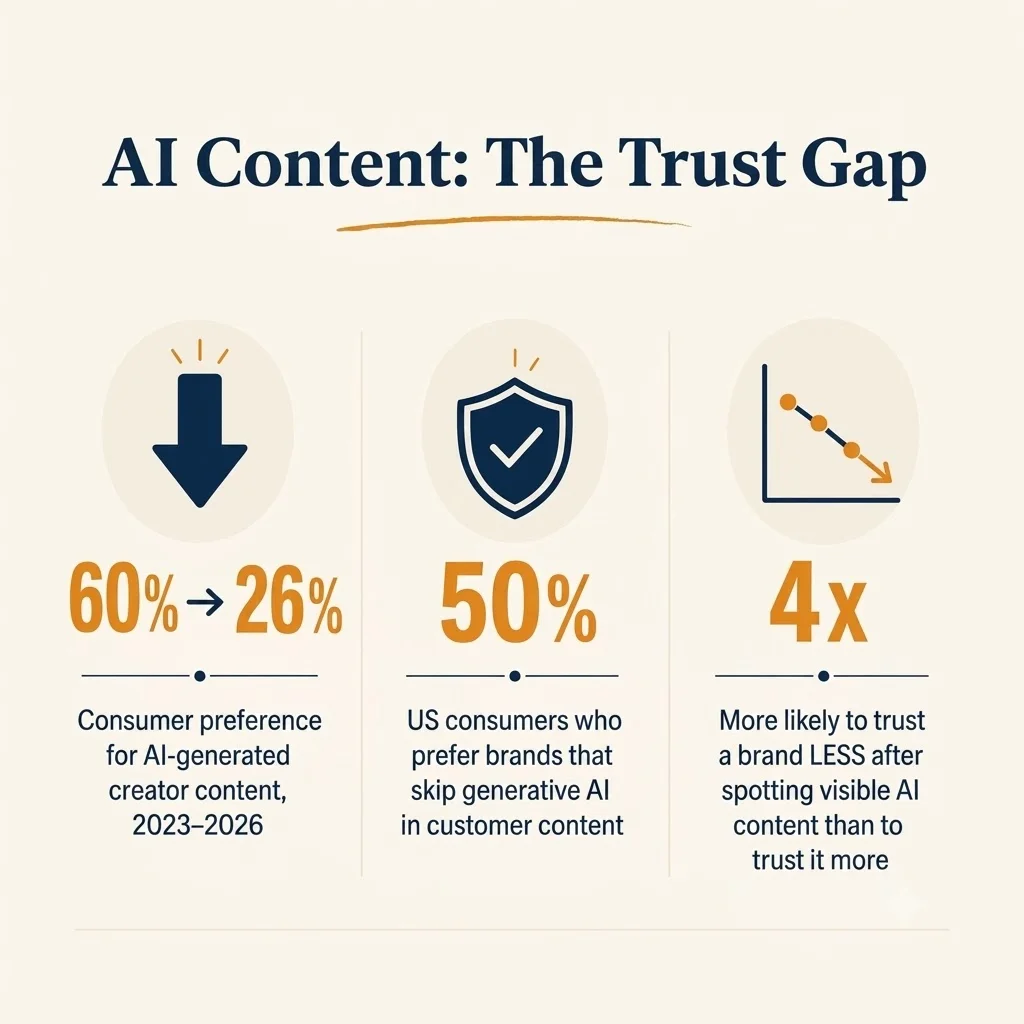
And people noticed. Not in a vague, hand-wavy way — in a measurable one. Consumer preference for AI-generated creator content dropped from 60% in 2023 to just 26% in 2026, according to influencer marketing firm Billion Dollar Boy — a genuinely fast reversal for something that was supposed to be the future. Around the same time, a Gartner survey found that half of U.S. consumers said they’d rather give their business to brands that skip generative AI in their customer-facing content altogether.
The clearest example probably wasn’t even in branding strategy — it was a Coca-Cola ad. In December 2025, the company released an AI-generated version of its long-running “Holidays Are Coming” holiday campaign. The internet’s reaction wasn’t mixed. It was mockery — people called it soulless, and more than a few joked it was the most effective ad Pepsi never had to make. Decades of built-up emotional equity, undone in one obviously-automated commercial.
Think about what happened to handmade furniture, craft coffee, or artisan bread once mass production took over. The handmade version didn’t vanish — it got a price tag people were happy to pay. Nobody’s paying extra for a mass-produced loaf. They’re paying extra for the one with the weird crust and a name on the wrapper.
Branding is going through the exact same split right now.
What "Human-Made" Branding Actually Means
Let’s clear up the misconception first: this isn’t about swearing off every tool. Nobody’s asking you to hand-letter your own invoices.
Human-made branding isn’t about avoiding technology — it’s about where the thinking comes from. The strategy, the story, the judgment calls: those still need to come from someone who’s actually talked to your customers, not from a chatbot guessing at your market.
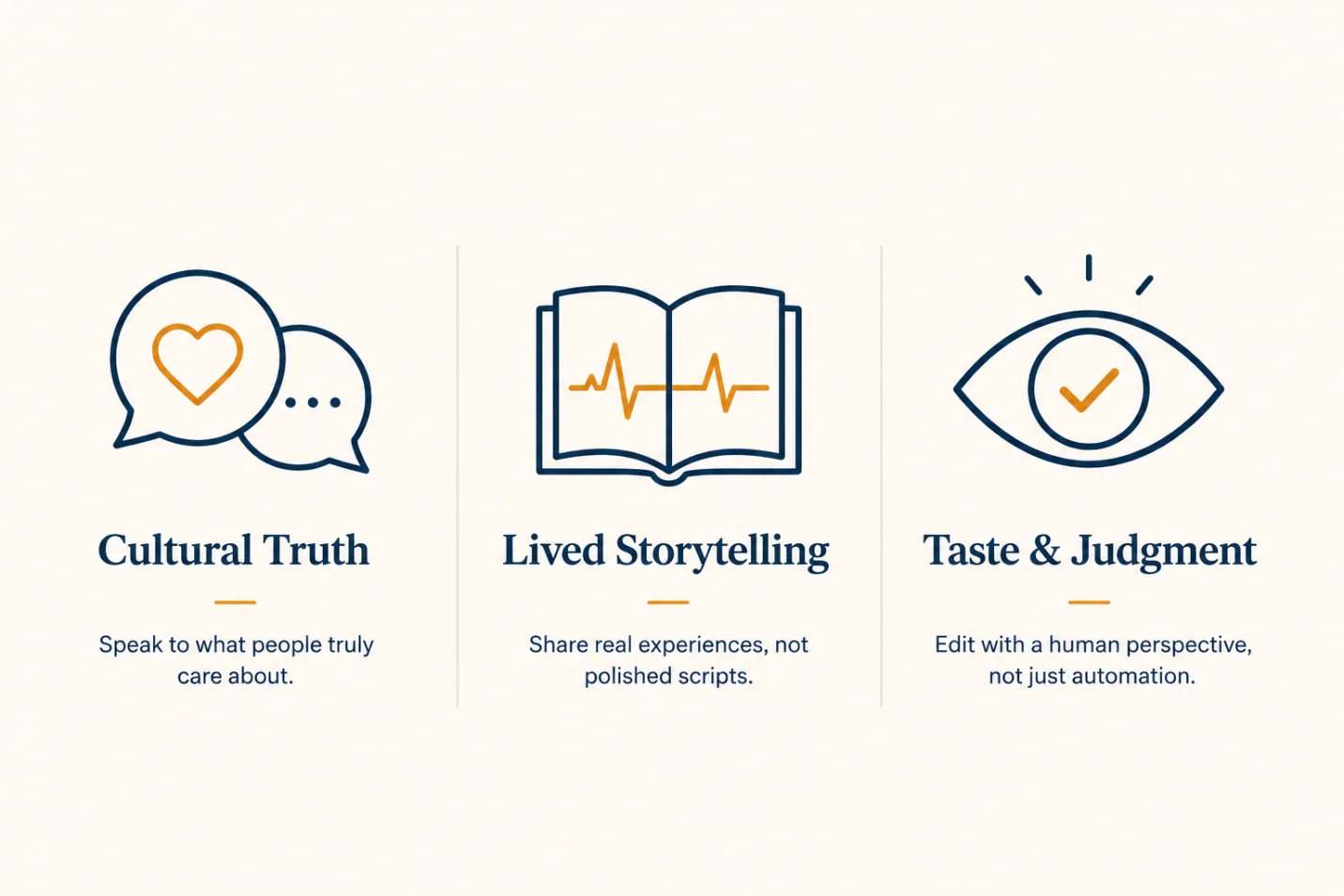
There are three things AI genuinely can’t do here, no matter how good the model gets:
Cultural truth. AI writes from averages. It knows what a thousand brands in your category have already said. It has no idea what your specific customer complained about to their spouse last Tuesday. That’s not a data problem — it’s an experience problem.
Lived storytelling. AI can write a perfectly serviceable founding story. It cannot feel the version where the founder maxed out a credit card, or almost quit, or got the idea from a genuinely embarrassing failure. It can only simulate specificity. It can’t have had a bad month.
Taste and judgment. This is the instinct that tells a designer “technically this works, but kill it anyway” — the difference between good and great that has nothing to do with correctness and everything to do with knowing when something’s almost right but not quite.
You’ve felt all three of these, even if you never had names for them. AI can write your tagline. It can’t tell you why your customers stay loyal at 2am when they’re comparing you to three competitors in another tab.
Where the Human Touch Actually Shows Up in Your Business
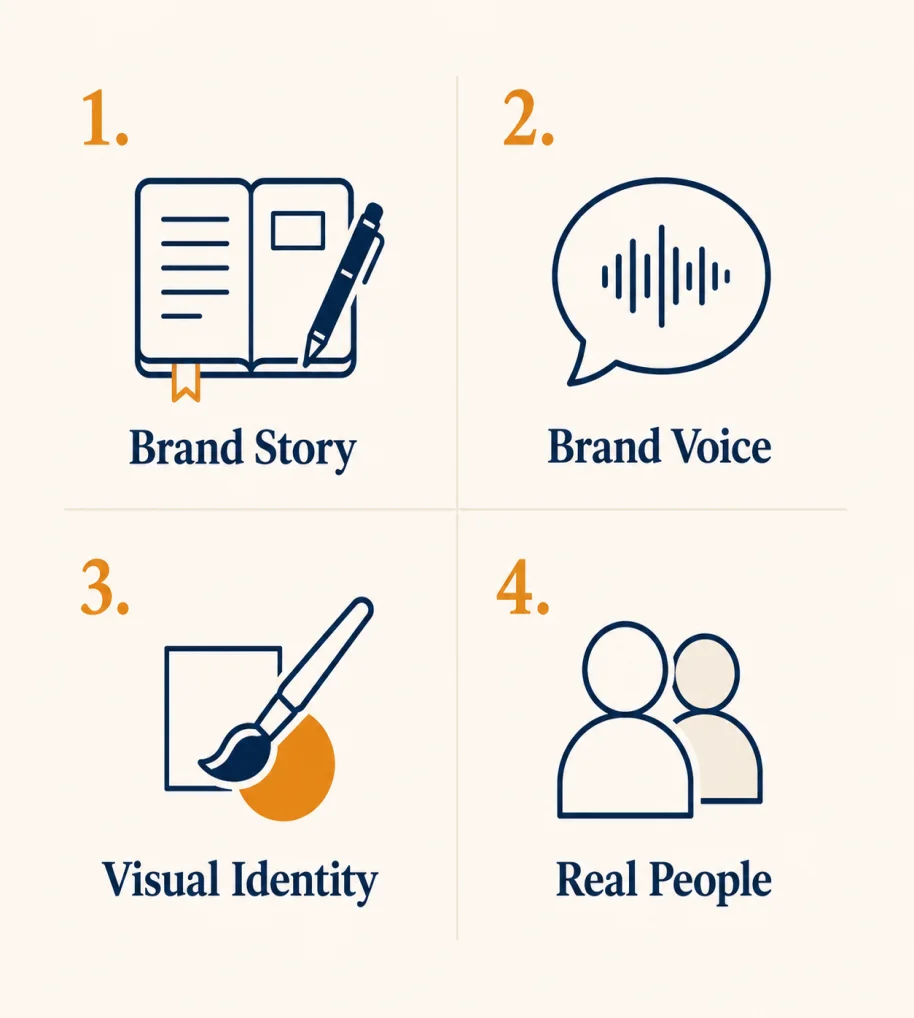
This isn’t theoretical. It shows up in four concrete places.
1. Your Brand Story (The Real One)
Most brand stories read like a template: “We started because we saw a gap in the market.” AI writes this version flawlessly — and it says nothing at all.
Compare it to something like: “We started because our founder got quoted $40,000 for a rebrand that was three PowerPoint slides and a mood board, and got angry enough to do it differently.” One of those you forget in ten seconds. The other, you repeat to a friend.
A human-made brand story digs for the real why — the actual frustration, the specific moment it clicked, the thing that felt personal enough to risk money on. That’s what builds emotional connection no prompt can fake.
Do this: Rewrite your brand story from scratch. Not the version that sounds impressive — the version that’s true. If you want a second set of eyes on that process, that’s exactly the kind of digging we do in our brand messaging work
2. Brand Voice That Sounds Like a Person, Not a Press Release
Here’s a genuinely fake tagline I just made up as a parody: “We’re passionate about synergizing tomorrow’s innovation, today.” If that sentence didn’t make you wince a little, we need to talk.
AI-generated brand voice tends to be safe, polished, and instantly forgettable — because it’s trained to avoid risk, and personality is a risk. Human brand voice has an opinion. It takes a stance. It uses an unexpected word here and there, and occasionally breaks a grammar rule on purpose because it reads better that way.
Do this: Write down three words your brand voice is, and three words it’s never allowed to be. Then run your last ten posts against that list and see how many fail. If you want a framework for building this out properly, our brand voice services start with exactly this exercise.
3. Visual Identity Built Around Your Actual Business

AI design tools can generate a logo in about 30 seconds flat. The catch: they’re generating it from patterns in existing design, not from any understanding of your business, your audience, or what you’re trying to make someone feel.
We’ve seen 30-second AI logos that could believably belong to a dentist, a crypto startup, and a coffee shop — same shapes, same gradient, same vaguely “modern” font. That’s the tell. If your logo could belong to any business in your category, it isn’t really yours.
Human-made visual identity starts with strategy — who you are, who it’s for, what feeling you’re going for — and the visual comes after that thinking, not instead of it. If you want that strategy-first approach applied to your own identity, that’s the starting point of our brand identity design process.
Do this: Ask yourself honestly — could a competitor swap logos with you and nobody would notice? If yes, that’s the AI-branding problem, live in your business.
4. Real People as Brand Channels
One of the clearest signals of a human-made brand right now: actual people talking about it. Founders posting something a little rough on LinkedIn. Employees sharing behind-the-scenes chaos instead of a polished reel. Customers telling their own version of the story, unprompted.
None of that scales through AI, and that’s exactly why it works. It’s the one channel that can’t be faked at volume, which makes it worth more the more everything else gets automated.
Do this: Pick two or three people close to your brand who could become consistent voices, and give them a dead-simple content framework so it’s not a blank page every week. Our social media marketing work usually starts by finding these people before it touches a content calendar.
The Business Case: This Isn’t Just About Feeling Good
Fair question if you’ve read this far: does any of this actually move revenue, or is it a nice story about craft bread?
It moves revenue. A few numbers worth sitting with:
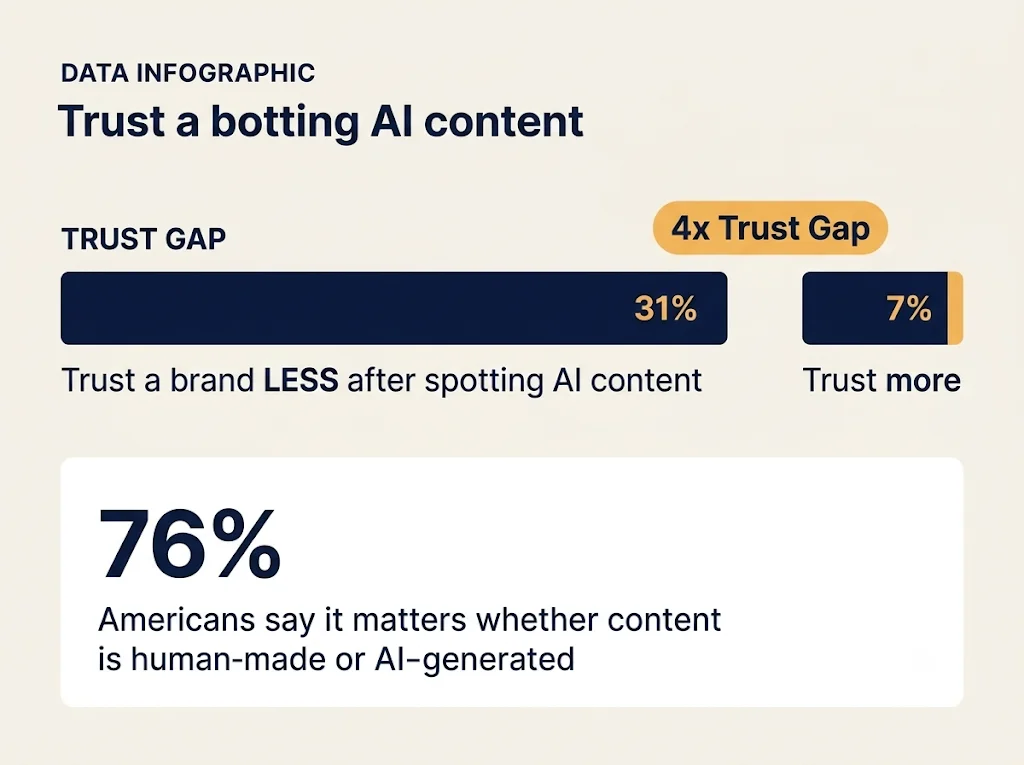
- When consumers notice AI-generated content in a brand’s marketing, they trust that brand less — and by a wide margin. A late-2025 Klaviyo/Datalily survey of 8,000 consumers found people were four times more likely to trust a brand less after spotting visible AI content than to trust it more (31% versus just 7%).
- Pew Research found 76% of Americans say it matters to them whether content was made by a person or generated by AI — this isn’t a fringe preference anymore, it’s most people.
- And in B2B specifically, this compounds: decision-makers aren’t choosing a vendor, they’re choosing a partner they’ll be stuck with for a multi-year contract. A brand that feels human-built earns the kind of trust that shortens sales cycles and generates referrals — the AI-polished version rarely does either.
Every real story told, every consistent human interaction, every piece of content that doesn’t sound like everyone else’s — that builds brand equity that compounds. Generic content doesn’t compound. It just gets scrolled past.
This is the kind of work that takes actual time — which, honestly, is most of what we do at Brandlogg. If that’s the kind of foundation you’re after, that’s what our brand strategy and planning work is built around.
Is Your Brand Human Enough? A 2-Minute Audit
Grab a coffee. Be honest with yourself for two minutes — nobody else has to see the results.
- Does your brand story include something specific and real — or could it be anyone’s?
- If you removed your logo from your content, would people still know it was you?
- Does your brand voice have an actual personality — or does it play it safe?
- Are real human voices (founder, team, customers) part of how your brand shows up?
- Does your visual identity come from strategy — or was it built purely for speed and cost?
Scoring: If you answered “no” to two or more of these, your brand is probably blending into the noise right now. The fix isn’t complicated. It just requires actually doing it, instead of prompting your way past it.
Frequently Asked Questions
The Brands People Remember Are Always the Ones That Felt Real

AI is a tool. Brand is a relationship. And relationships, as far as we can tell, are still built by people.
The businesses winning right now aren’t the ones who spent the least on branding — they’re the ones who invested in something that actually means something to someone. That’s a harder thing to build and a much harder thing to copy, which is exactly why it’s worth doing.
If your brand currently sounds like it could belong to literally anyone… let’s fix that.

