Table of contents
- Why Every Brand Suddenly Sounds the Same
- Why AI Generates Generic Content
- The Biggest Mistakes Brands Make With AI
- Why Brand Strategy Matters More Than Ever
- The SPARK Framework for AI-Assisted Branding
- Case Study: Turning a Generic AI Draft Into a Distinctive One
- Real-World Examples of Brands That Never Blend In
- AI Content vs. Human Content: A Comparison
- A Category-by-Category Content Checklist
- Conclusion
- FAQ
How to Keep Your Brand Creative From Looking Like Everyone Else's AI-Generated Content
Open five competitor websites right now and go through all “About Us” pages one after another.
Do you notice anything? All of them talk about “empowering”, “elevating” & “unlock possibilities.” Putting “their customer first” is another important point for them. Most of the brands claim to be “innovative” & “passionate”. Just swap their logos and nobody would know the difference.
Well this did not happen by chance. What we witness nowadays is that thousands of great brands are typing the same prompts & publishing the output as it as without making any modification. This results in strange kind of sameness that is technically correct but definitely not memorable at all.
This should be remembered at the very beginning: a machine can only write what is probable; however, a brand is remembered for that very thing it wrote, which was different than everybody else would have done writing this.
This blog guide is about saving this unique insight from the influence of AI – not by avoiding AI writing, but using it in the same way a strategist would use a hammer – as a normal tool doing what it should do.
Why Every Brand Suddenly Sounds the Same
Almost every brand today sound the same because they skipping the most important part, The strategy and going straight to generation – for example: simply asking a tool to “write a blog post on X” instead of feeding it a unique point of view.
Following a generic prompt yields generic results because the AI model follows directions. It generates anything reasonable on the subject without reputational worries. There are no clients to take care of and no failures suffered. It simply finds the most likely word and, since that is the very nature of how things work, it will be a normal one.
If you apply this to the whole industry you will see that everything becomes similar. All SaaS companies claim to be “the modern way to do something.” All cosmetic brands promise to be “clean, scientific and cruelty-free.” They do not lie; they just use generic expressions. Generic companies compete in terms of price – as all they have left is pricing when they can no longer communicate with words. This is precisely where a company’s broader digital marketing strategy has to pick up the slack — pricing pressure is what happens when nothing else about the brand is distinct enough to compete on.
Why AI Generates Generic Content
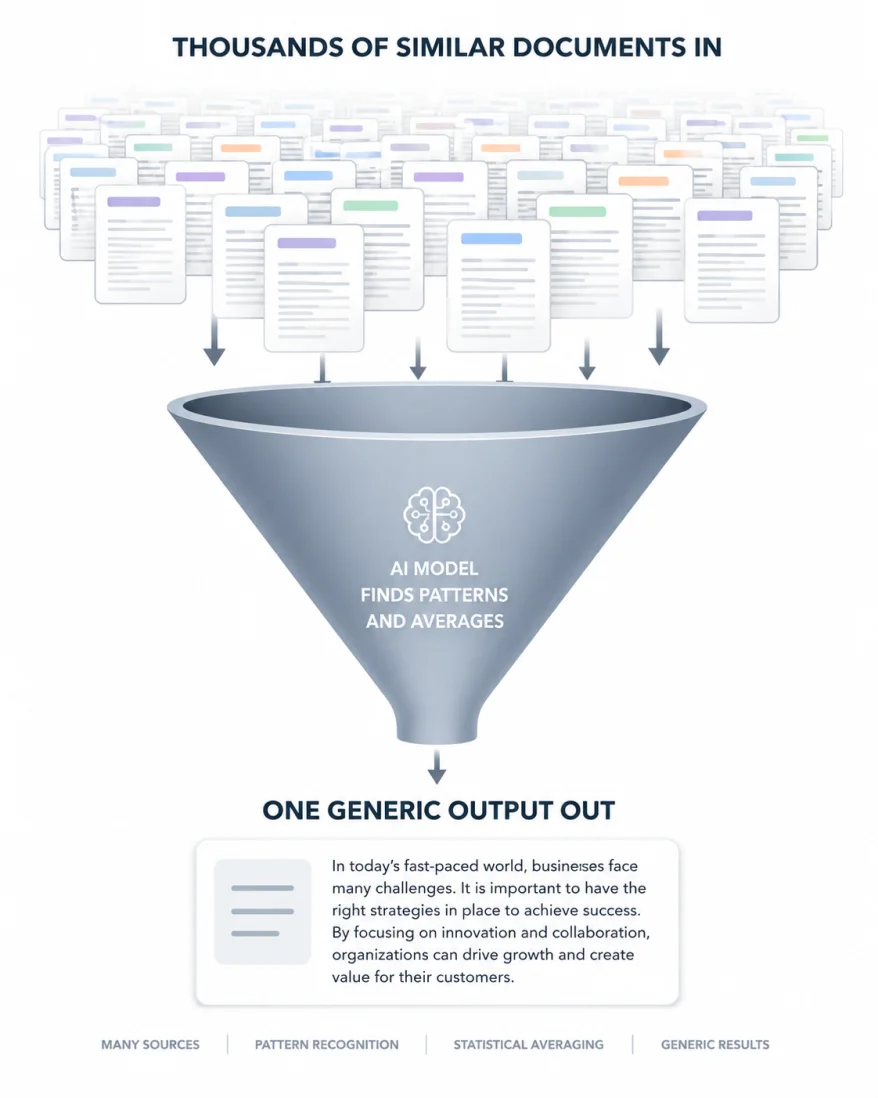
Language models generate the most likely upcoming word based on patterns found in countless texts, which leads to producing text that is statistically average – that is, not very unique.
An example of this would be asking a crowd of 1000 people to finish the phrase “Our company is committed to…”. The answers will contain terms such as excellence or innovation more often than another true and specific word. The model is a representation of the crowd. It does not know that your company´s founder has fought with an investor about prices or that your support team had to travel two hours to assist a customer with fixing their installation. It only knows what is being widely used unless it gets told otherwise.
Most people also prompt the model with a task (“write a blog about X”) instead of an identity (“here’s who we are, what we believe, and who we’re talking to — write inside that”). Task-first prompting tends to produce task-shaped writing. Identity-first prompting tends to produce a real voice.
The Biggest Mistakes Brands Make With AI
Some fundamental errors include:
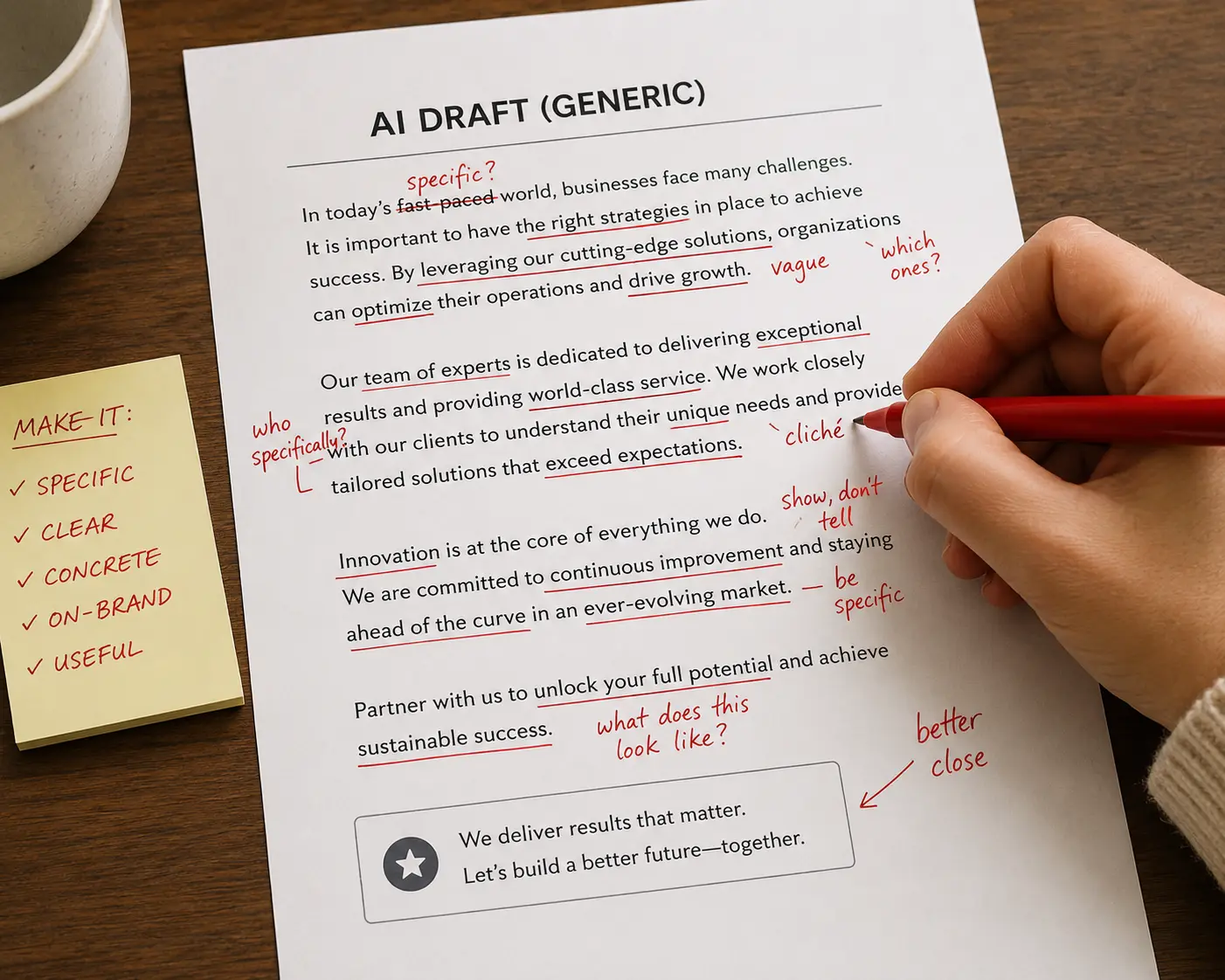
- Publishing the first output unchanged, with all its clichés and flaws
- Not giving the AI any authentic examples of the company’s tone of voice
- Applying AI for ideation rather than execution
- Neglecting editing because the draft “sounds fine”
- Leaving out any proprietary information, thoughts, or original examples
- Optimizing only for keywords and not for specific reader issues
Common Mistake – The main error is that asking a tool to “make it sound more human” after the fact, it almost never works. The human touch has to be the part from the start and not glued on later – and that’s exactly why this is a strategic fix, not an editorial one.
Why Brand Strategy Matters More Than Ever
With production being affordable and unlimited, the only remaining scarcity is a distinct viewpoint. For the past two decades, the challenge of publishing has been the expense of producing content. The problem, however, has been eliminated, hence creating content itself is no more the competitive edge.
According to Google, the problem in production of content is not the use of AI as its ranking technologies are intended to reward the content that possesses true expertise, experience, authority and trustworthiness irrespective of the way it has been created (Google Search Central, Google Search’s guidance regarding the AI-generated content, 2023). Its sister advice on useful content explicitly requests creators to evaluate their work through a simple test asking whether the publication has some new ideas in it or is just repeating somebody else’s thoughts (Google Search Central, Create Useful, Trustworthy and Audience-Centric Content).
The data illustrates just how important that distinction is. A 16-month independent study that tracked 2,000 AI-written pages found that rankings did not last long without proper authority — pages that were ranked in the top 100 dropped from 28% in month one down to only 3% in month three (Search Engine Land, 2026). Furthermore, an analysis of 42,000 of the best-performing blog pages showed that AI-generated content was ranked #1 only 9% of the time compared to 80% for those written by humans (Semrush, 2026). AI-generated content that has been edited and developed by a human works better than raw content — and that difference is the essence of everything said in this guide.
This is the exact gap our Search Engine Optimization Services team is built to close: pairing AI-assisted speed with the editorial judgment that keeps rankings from fading.
The SPARK Framework for AI-Assisted Branding
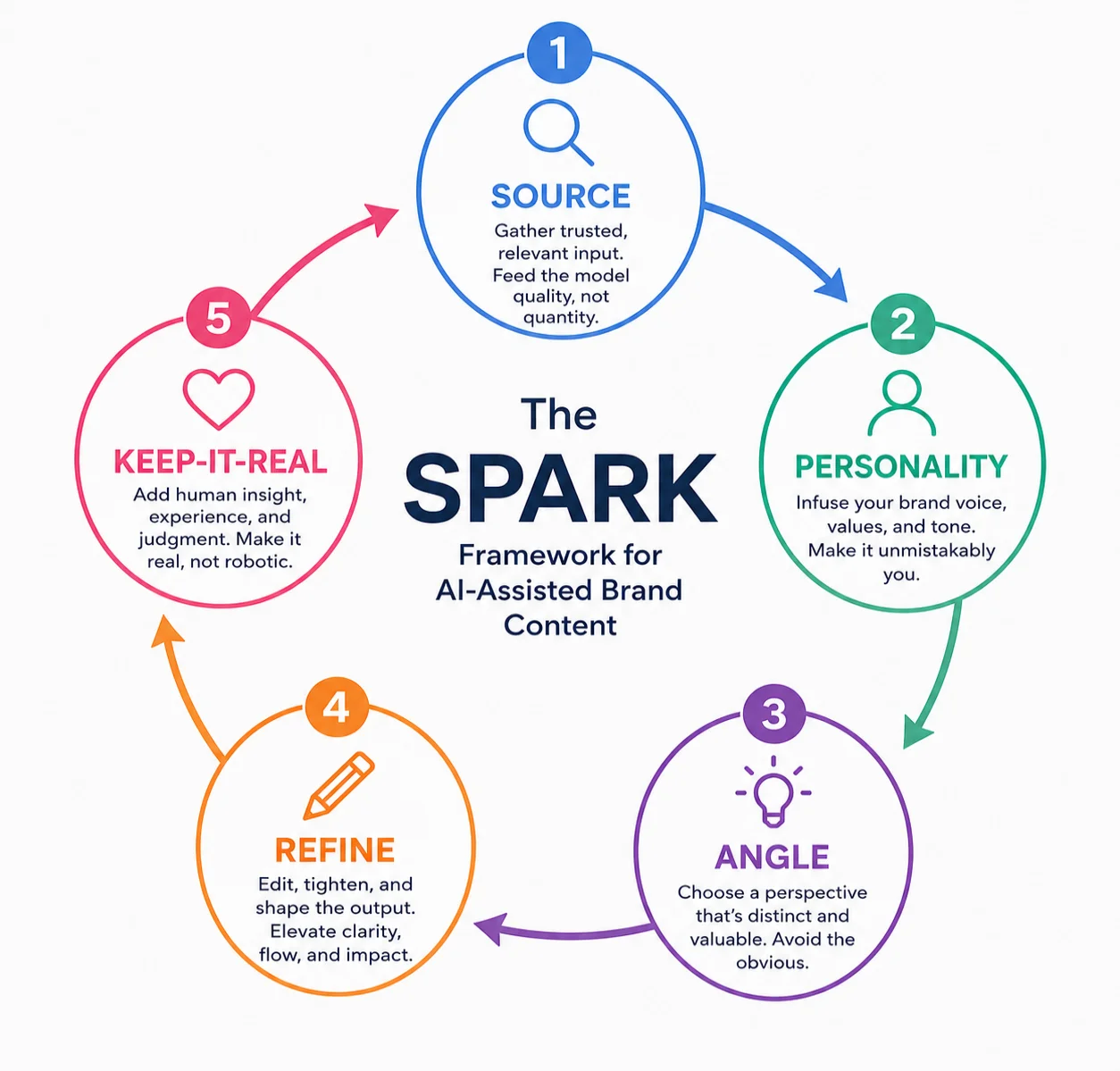
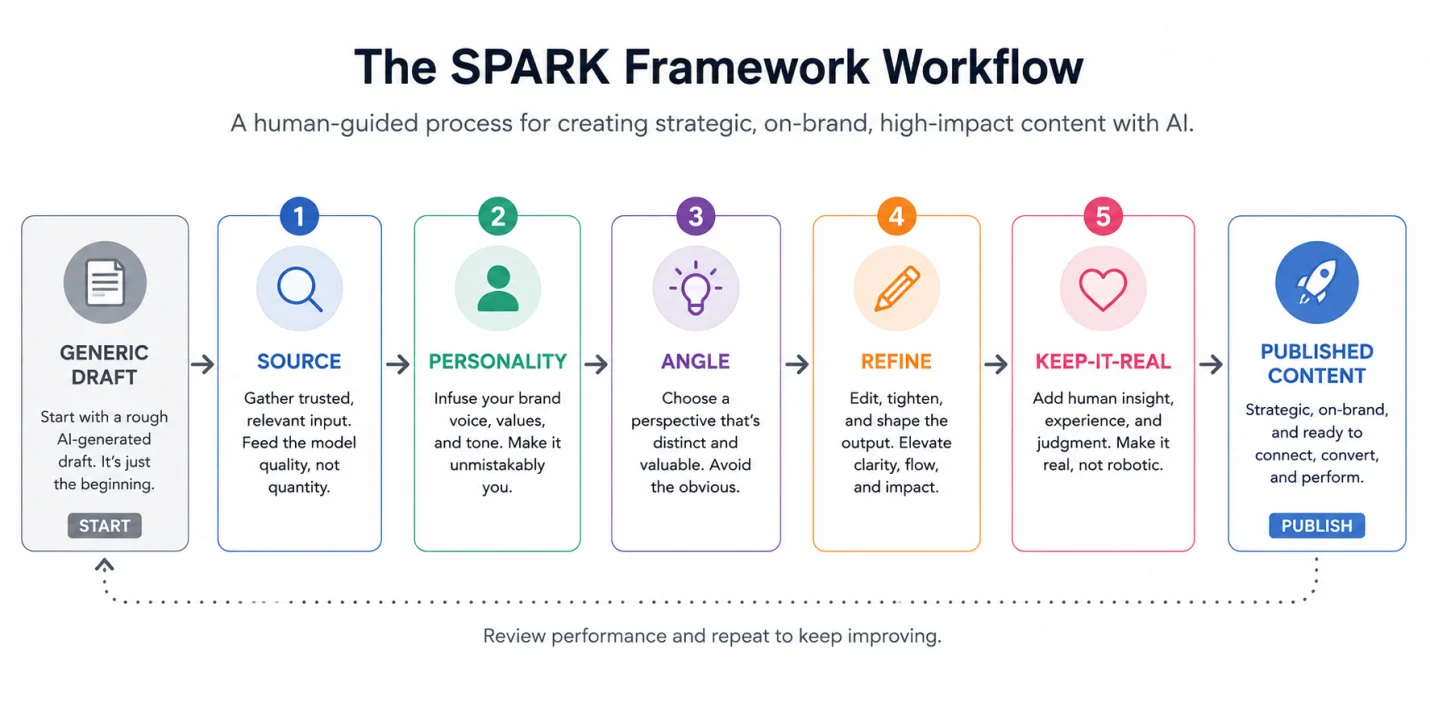
Utilize the SPARK Framework to guide you through your writing process with the following five steps as your guide from the first draft to the final published draft.
| Step | What It Means | The Question to Ask |
| S — Source | Based on real-life experiences or data | “What do we know that nobody else does?” |
| P — Personality | Determine 3-5 different voice traits and banned words | “Can this text be identified as ours without the logo?” |
| A — Angle | Select one other allowed perspective | “How far are we willing to go against the industry?” |
| R — Refine | Perform an editing pass for style | “What can we cut without losing meaning?” |
| K — Keep-it-real | Include a real-life example before publishing | “What proves this is not just fiction?” |
Pro Tip: Execute the Personality step once. Record a concise voice guide indicating 5 voice features and 5 prohibited expressions. If you’d rather have a second set of eyes build this with you, our branding services team develops voice guides like this for clients from scratch.
Expert Insight: The source step is often omitted by many businesses and it is the most important step. Any generic piece that has a specific detail added will be generally perceived as more credible.
Case Study: Turning a Generic AI Draft Into a Distinctive One
A medium-sized project management company required a homepage tagline for their new collaboration tool. The brief was as follows: “Create a headline and a brief paragraph announcing our new feature of team collaboration.
“Generic AI output:
“Introducing our new Collaboration Hub — the smarter way to work together. Empower your team to stay connected, boost productivity, and unlock seamless collaboration, all in one place.”
There is nothing wrong in it but also nothing in it is memorable either — those same kind of phrases appear on homepages of dozens of competitor.
Applying SPARK: Customer interviews (Source) showed an issue related to updates “getting lost” in five different tools, which caused people to learn of decisions late, in meetings. The brand’s voice guide explains the need for a “direct” message, and the need to stay away from buzzwords like “seamless” and “unlock.” The Angle defined the change from talking about the “seamless” feature to identifying the real reason for the failure: most tools connect people, yet they do not let the information be found. The Refine phase has removed all adjectives that did not add value.
Improved version:
“Stop finding out about decisions a week late. Collaboration Hub keeps every update in one searchable place, so your team isn’t relying on someone remembering to forward the email.”
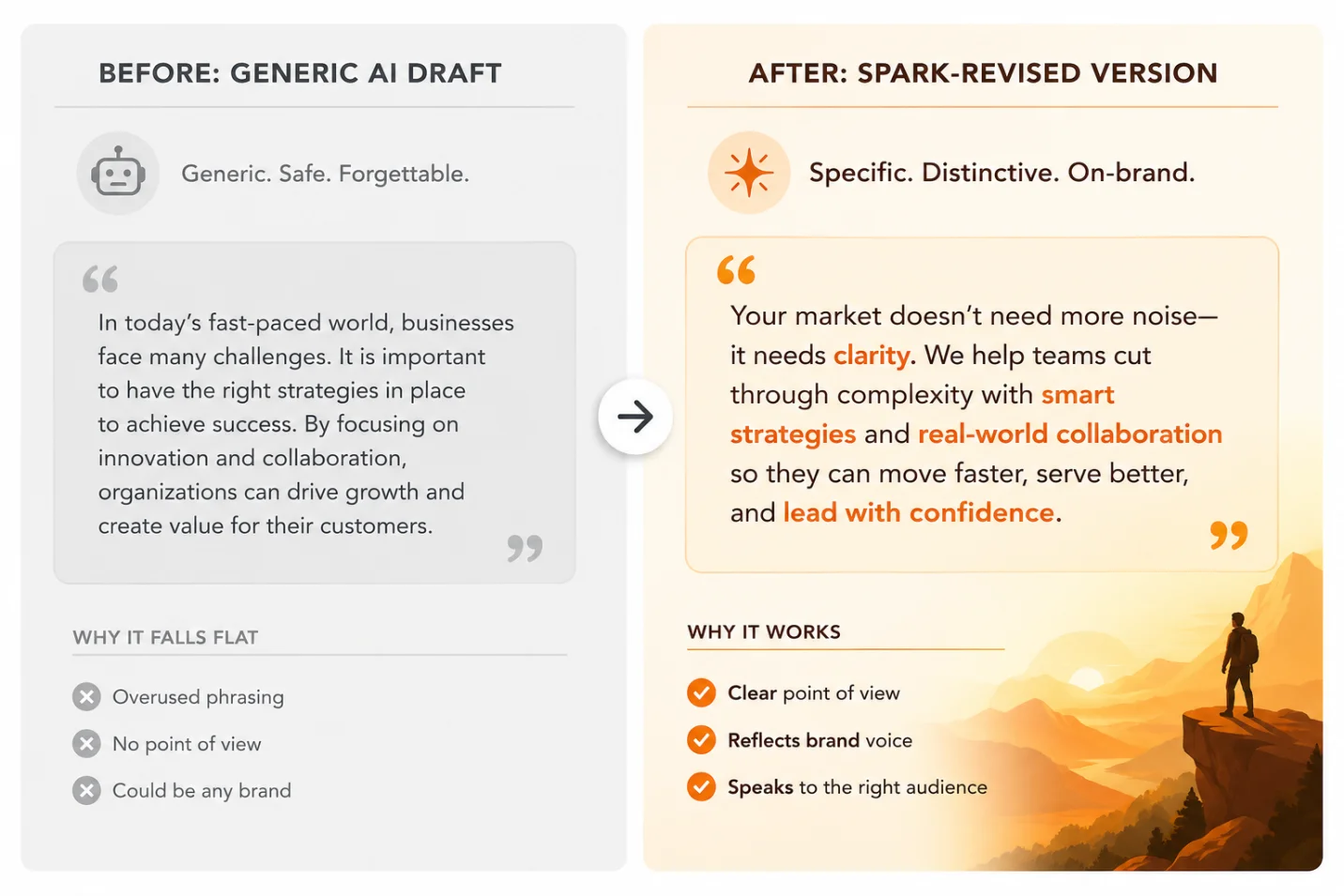
The generic version stated an entire range of advantages. The revised version provides an actual identifiable instance of frustration, which a generic description cannot do, as it shows that the particular company talked to real users and provides the reader with something they may relate to.
Lessons learned: Specificity is better than adjectives. The most appealing approach comes from a customer complaint, not a list of benefits. Sometimes splitting sentences creates more credibility. None of this is about new knowledge; the only thing needed is some common sense and asking what clues we already have and what we have omitted in previous descriptions.
Real-World Examples of Brands That Never Blend In
- Apple is one of the least verbose tech companies out there. The restraint is a sign of confidence because a brand that could justify a product in just three paragraphs is essentially saying the product itself doesn’t sell.
- Nike hardly mentions shoes. Instead, it sells the idea of determination and identity since that motivates people more than any features of the shoes.
- Airbnb transformed itself from “book a room” to “belong anywhere,” changing the concept with the focus on human connection instead of efficiency.
- Duolingo’s voice in social media is rather quirky and self-aware, demonstrating a level of unpredictability no marketing professionals could have achieved.
- Unlike marketers, Notion communicates in the voice of a passionate organizer, which was taken from the company’s early community, rather than invented by someone.
- Netflix utilizes captions based on particular shows or events rather than generic expressions because specific messages travel better than general statements.
All these companies do not shy away from using new tools for research & production. However, they do their best to avoid generic thinking. The differentiating factor is not the tool, but the angle — and that angle is exactly what strong brand identity design work is meant to define and protect across every touchpoint, not just the homepage.
AI Content vs. Human Content: A Comparison
| Dimension | Original AI Writing | Content Created with Intent |
| Perspective | Neutral, general | viewpoint is specific; sometimes opposing |
| Types of illustrations | Generic or fictitious | Unique, sourced |
| Word Usage | Repetitive and predictable | Various usage of words according to the brand |
| Degree of credibility | Very low; it appears as a template | Very high; it sounds credible |
| Longevity of ranking | The content loses its effectiveness over time | Ranking appears to be stable when combined with editorial skills |
The gap between these two columns isn’t the model. It’s whether a human with real context sat in the loop before publish.
A Category-by-Category Content Checklist
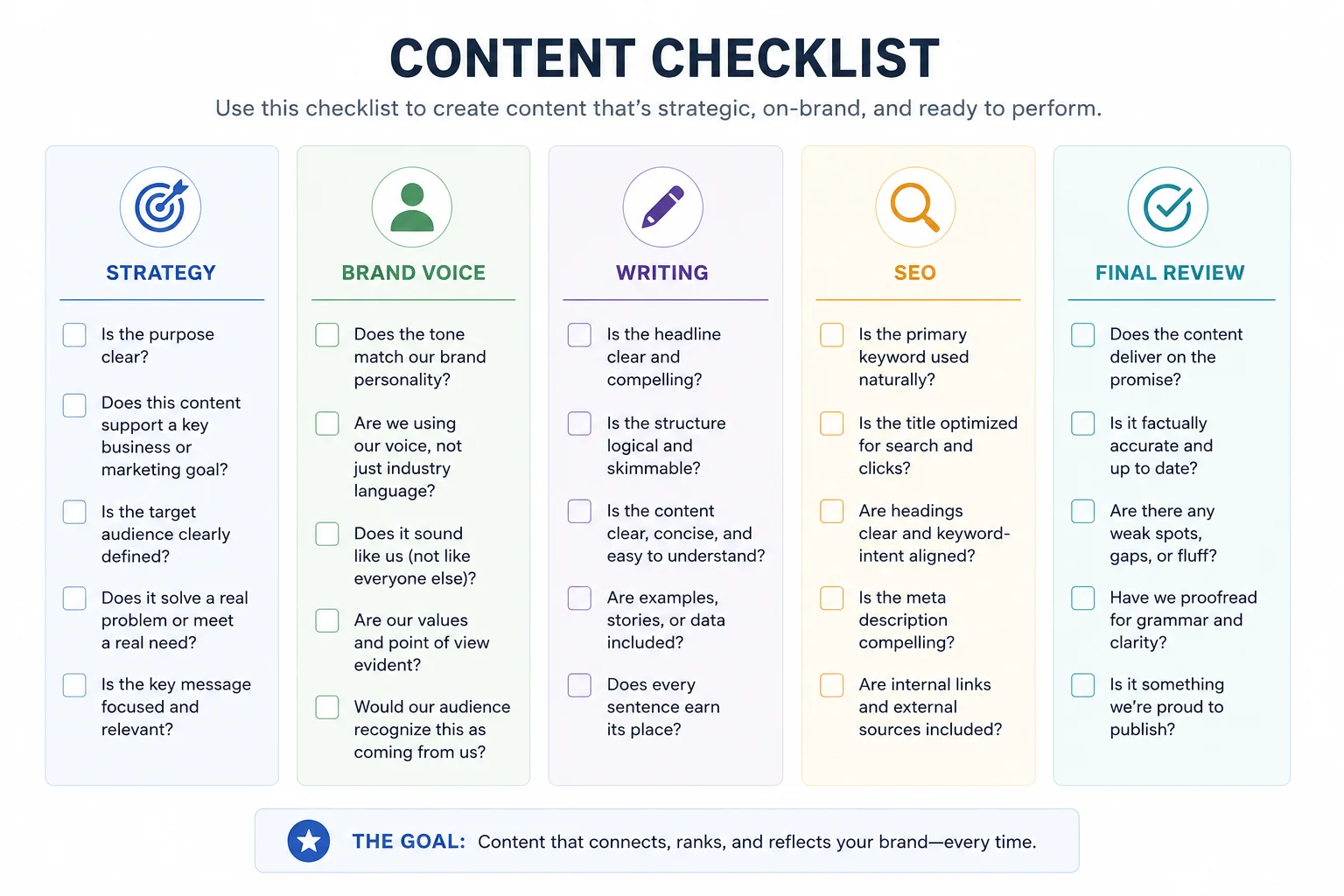
Strategy – Does this reflect any actual knowledge about the customer? Does it offer a view that can be debated? Could your target customer identify the brand behind the message without knowing the author?
Brand Voice – Is there a voice document that corresponds to each message? Did you take out expressions such as “in modern world,” “award-winning” and other clichés that do not add any meaning? Are sentence lengths different?
Writing – Does your piece start with a focused insight? Is there a specific example or anecdote used? Was the conclusion written by a human being?
SEO – Is there a clear main keyword instead of multiple confusing ones? Are the headings formulated as questions? Are the statistics cited?
Final Review – Did you consider how competitive brands covered the topic? Did you take out each statement that cannot be supported? Is there a definite call to action?
Conclusion
AI has not invented branding sameness; it has merely made it easier to notice. So, the answer is not simply “don’t use AI.” Instead, it is ensuring that you have something meaningful to say before you even open the prompt box — an actual problem, an actual example, an actual reason for customers to trust you instead of their next browser tab.
Use SPARK to develop your voice guide on 1 page. Make someone responsible for the parts that require having actually run your business. This way, the program you used becomes less equal to what you wrote.
Machines can only generate what is likely. What you must come up with, though, is what needs to be said and cannot be said by anyone else.
If you’d rather talk this through than tackle it alone, get in touch with our team — we help brands build the voice guide and content system this guide describes.
FAQ
No, this is where it is effective most of all. The danger lies in publishing the draft without human involvement of the writing.

