Table of contents
- What to Look for in Brand Strategy Consulting Firms (And Why It Matters
- First, What Does a Brand Strategy Consulting Firm Actually Do?
- The 6 Things That Actually Separate Good Firms from Average Ones
- Red Flags to Watch For
- The Types of Firms Out There — And Which One You Need
- Questions to Ask Before You Hire Anyone
- Why Brand Strategy Is Worth Getting Right
- The Bottom Line
What to Look for in Brand Strategy Consulting Firms (And Why It Matters

Most of the businesses hire a brand strategy consulting firm twice. Once because they need one for strategy and once because the first one did not work out.
Well this doesn’t mean the all the consulting firms are bad or lack credibility; it just reflect the fact that how murky, kinda slippery this space really is. The use of the term “brand strategy” is ubiquitous throughout the business world, as are the phrases “clarity,” “purpose,” and “authenticity,” which seem to appear on every business’s homepage and/or deck of case studies. But then how can one differentiate between a company that’s going to change the way your market perceives you from one that’s simply going to provide a 60-page PDF document?
First, What Does a Brand Strategy Consulting Firm Actually Do?
Let’s be honest – the term gets thrown around loosely.
A firm that does consulting for the brand strategy will help you in finding out who you are as a business. why that matters to the people you are trying to reach and how to communicate this with consistency across every point of contact.
Branding is way more than just a logo or tagline; and when done right, your branding will be the foundation for everything like marketing decision, product decision and hiring decision.
The work typically involves:
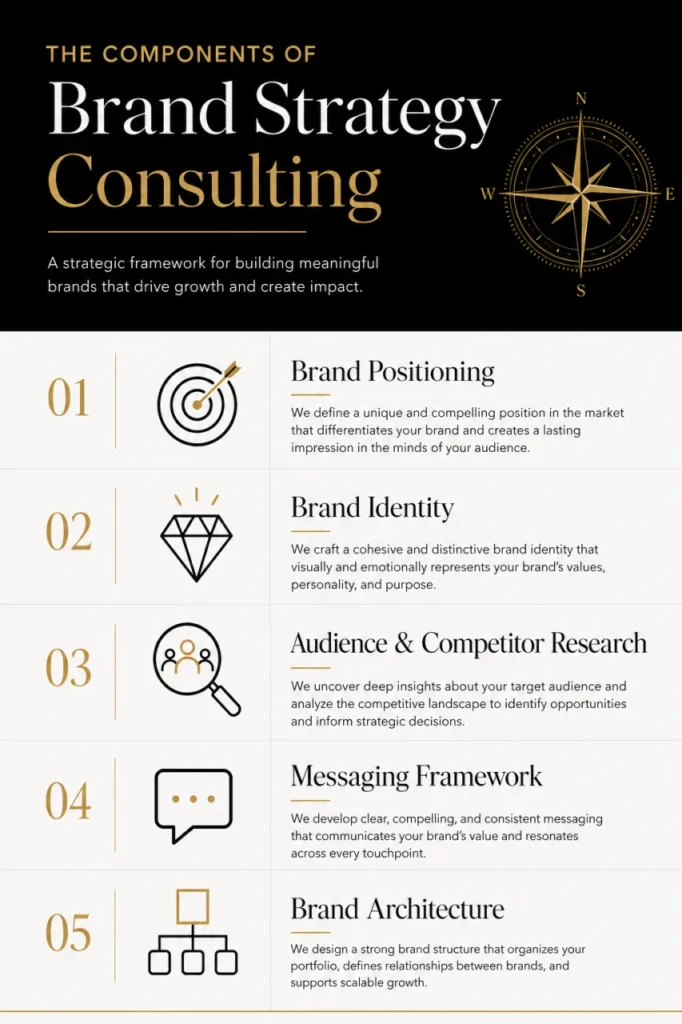
- Brand positioning — The positing defines where you sit in the market & why someone should choose you over everyone else
- Brand identity — It translate strategy into visual & verbal language
- Audience and competitor research — It helps in discovering the real story, rather than assuming one.
- Messaging frameworks — It gives your whole team a consistent way to talk about what you do.
- Brand architecture — especially relevant if you have multiple products, sub-brands or are going through a merger.
Some firms do all of this. Some specialize. That distinction matters — more on that in a moment.
The 6 Things That Actually Separate Good Firms from Average Ones
1. They Ask Hard Questions Before Pitching Anything
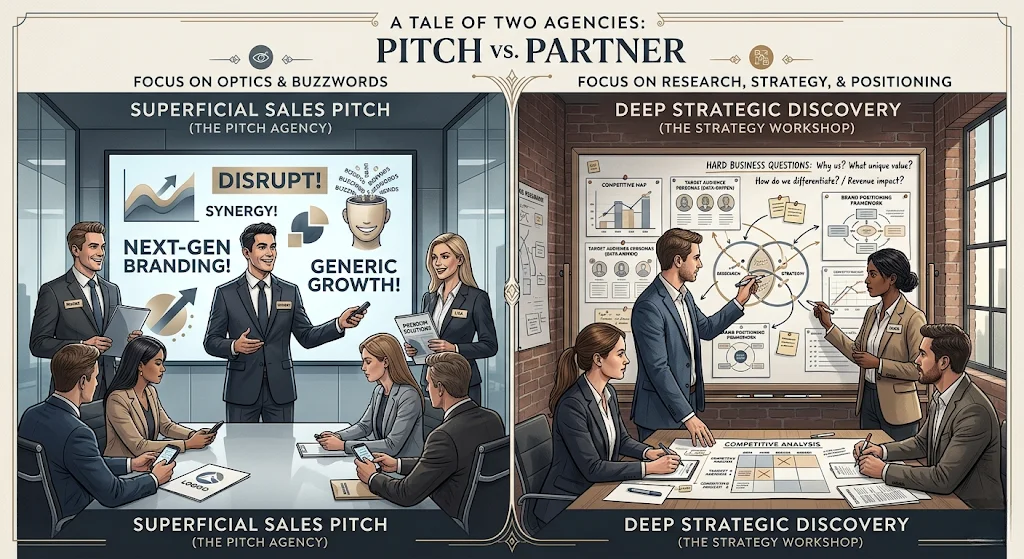
A firm that is worth hiring does not come in with solution in just one day. They come in with questions. And sometimes uncomfortable one like why your last launch underperformed, who you are really competing with, whether your current brand is actually holding you back or problem is elsewhere.
And if your first meeting with a firm feels more like sales presentation than a discovery session, well that’s worth noticing.
The best brand strategy partners are curious first. Before starting they want to understand your business deeply and then suggest anything. Because they firmly believe that a strategy built on assumptions is not a strategy – it’s guesswork with a nice font.
2. They Have Real Positioning Work in Their Portfolio - Not Just Pretty Branding
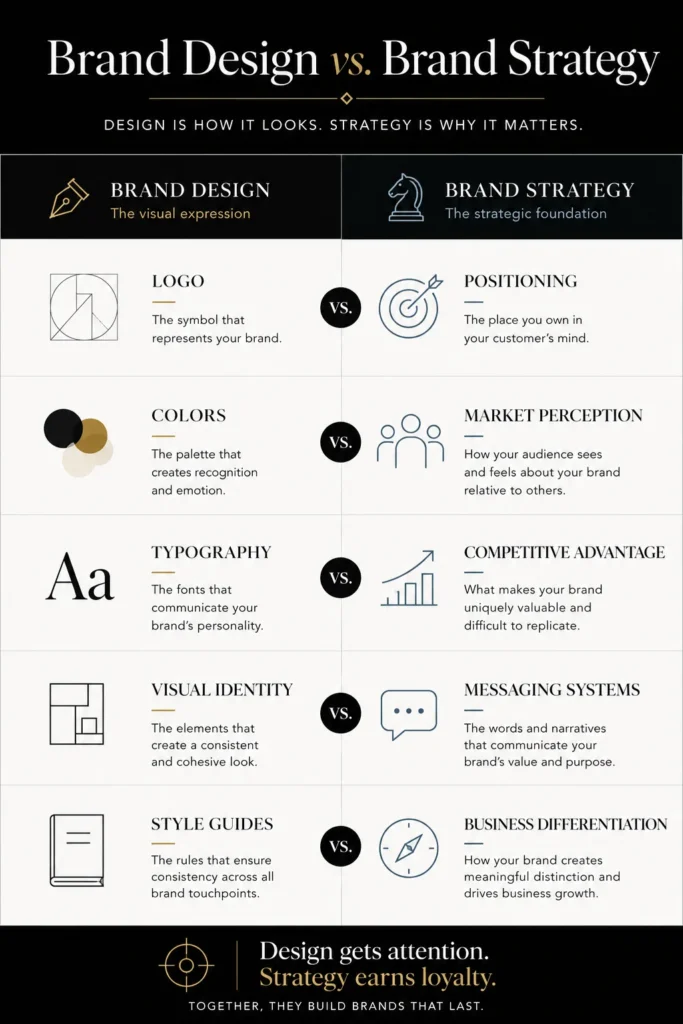
Well there is a difference between a firm that does brand design and the one that does brand strategy. Both of them have their own place. But if you are hiring for strategy, you want to see evidence of positioning work and not just visual identity.
So before hiring ask them: “Can you show me a project where the positioning you developed changed how a client competed in their market?”
Then look for specifics, real outcomes. Not “we helped them find their voice”, but more like “their sales cycle shortened because prospects started arriving already persuaded”, you know? basically the gap between a design-led firm and a strategy-led firm shows up in how they talk about results & what they actually claim improved.
At Brandlogg, we don’t treat brand positioning as a checkbox in fact we believe that it’s the foundation from where everything else builds. Before a single design decision gets made, the strategic groundwork has to be solid.
3.Their Process Has Structure — But Isn't Rigid
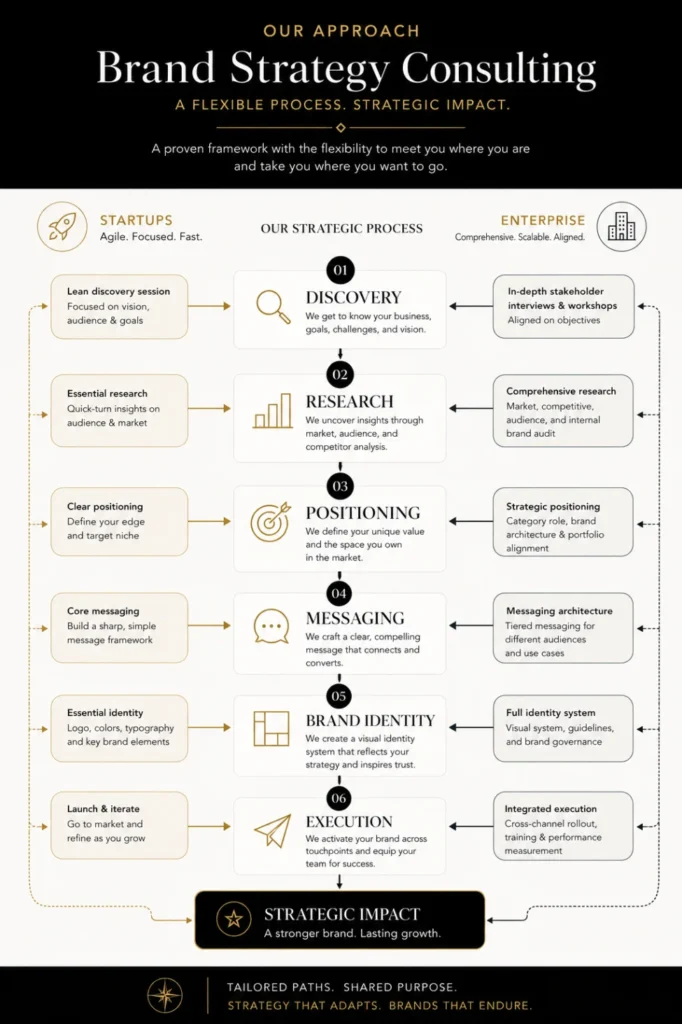
The effective companies have a methodology. They can give you a rationale for how they go from research through strategy to execution and provide you with a rationale for why they did it this way – you should not feel like you’re purchasing a black box.
However, the best are also flexible. They know that an established company that is repositioning after over two decades has different requirements than a new startup is trying to identify product-market fit. Using the same cookie-cutter process for everyone is often indicative of firms optimizing for processes and not for results.
You should be able to ask them, like honestly, how their process changes depending on the client’s needs or objectives; and if they answer, “it’s the same for everyone” then just watch out.
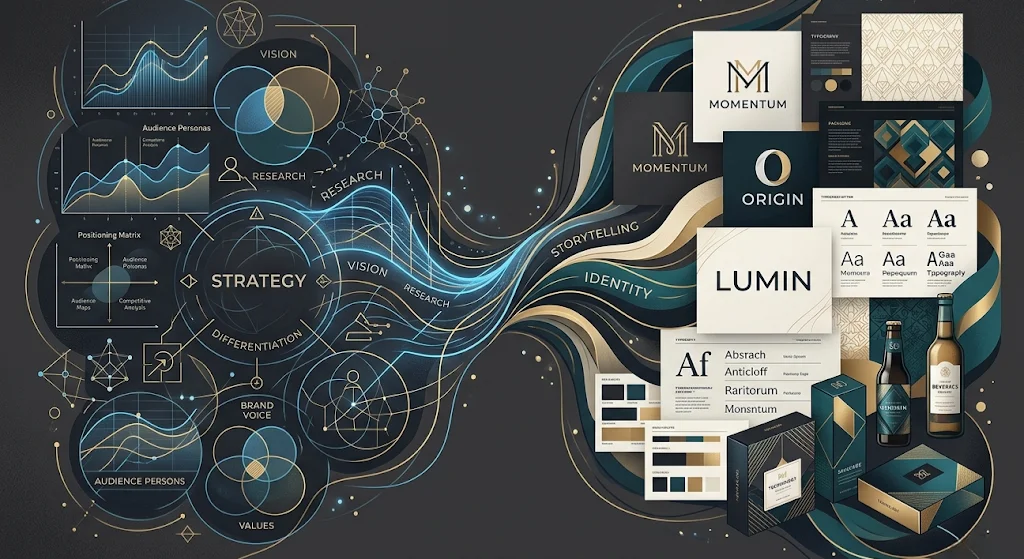
4.They Understand That Strategy and Identity Are Connected — Not Separate Projects
This one gets overlooked more than it should.
There are companies who will provide you with the brand strategy document and send you out looking for a design agency to implement it. Sometimes this works fine. Other times there is a disconnect — where the design team sees the strategy through their own eyes and something is inevitably lost.
The best relationships are those where both strategy and brand identity design are created simultaneously — where brand identity truly evolves from the brand position rather than merely being inspired by it.
When interviewing agencies, one question I always ask is, “Do you do both strategy and identity work, or do you refer clients to other companies for those services?” Neither response is inherently correct or incorrect, but you need to know.
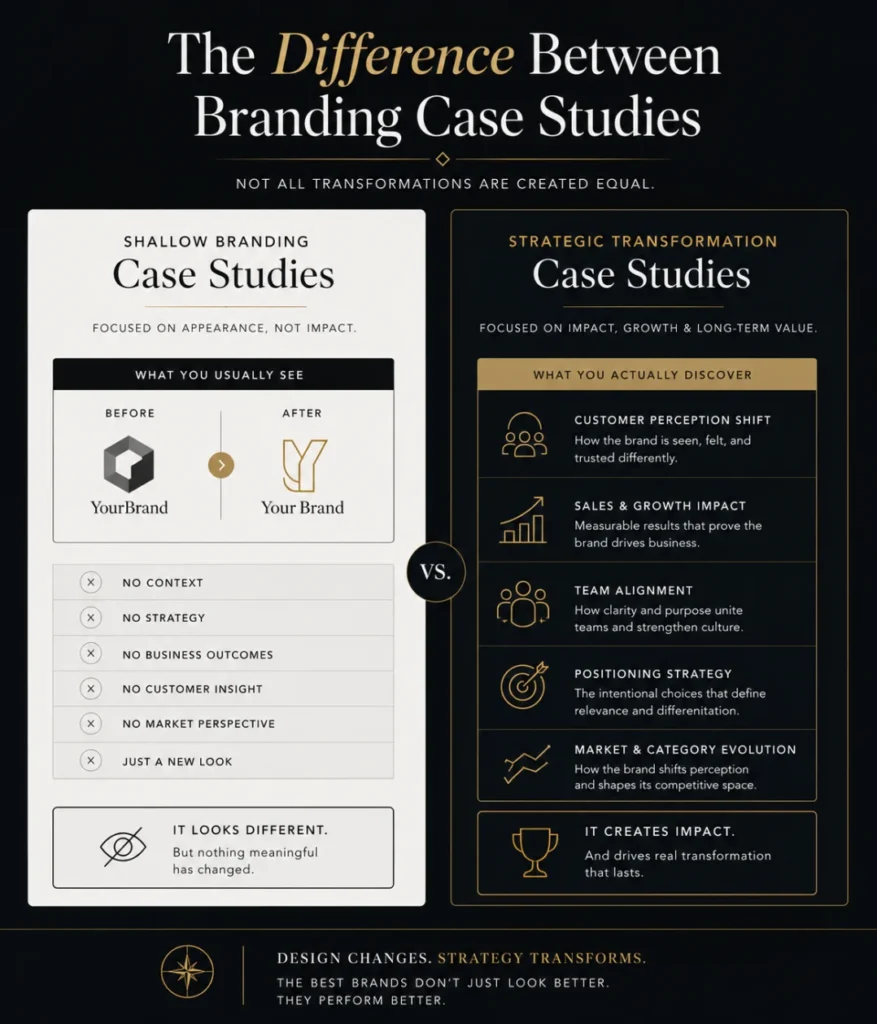
5. Case Studies That Go Deeper Than Logos
Every firm shows their best work. That is kind of table stakes, you know.
The thing you really wanna dig into is the story behind that work. Like what was the business challenge, for real? What did the firm recommend, and, why it made sense to them at that moment? And what shifted after the rebrand or repositioning— in terms of how customers saw things, how the team lined up, and whether market performance actually moved?
Good case studies have texture, not just a glossy finish. Real ones include the tensions and the trade-offs, not simply the final outcome.
Take a look at Brandlogg’s work with Lal Qilla — a heritage brand that needed to evolve without losing the equity it had built over decades. That kind of work requires strategic sensitivity, not just design skill. It’s a completely different challenge than building a brand from scratch, and it shows in how the problem was approached.
6. They're Honest About What They Can't Do
Nobody really is great at everything. A studio that focuses on B2B tech rebranding probably won’t be the perfect partner for a consumer lifestyle brand, cause the whole vibe is different. And a company that’s super strong at big, corporate identity systems might not be the right match for a smaller boutique business that needs speed and flexibility, like real agility, not just on paper.
The top firms will tell you when you’re not the right fit for them. That kind of candor is rare… and it reads as confidence not weakness.
Red Flags to Watch For
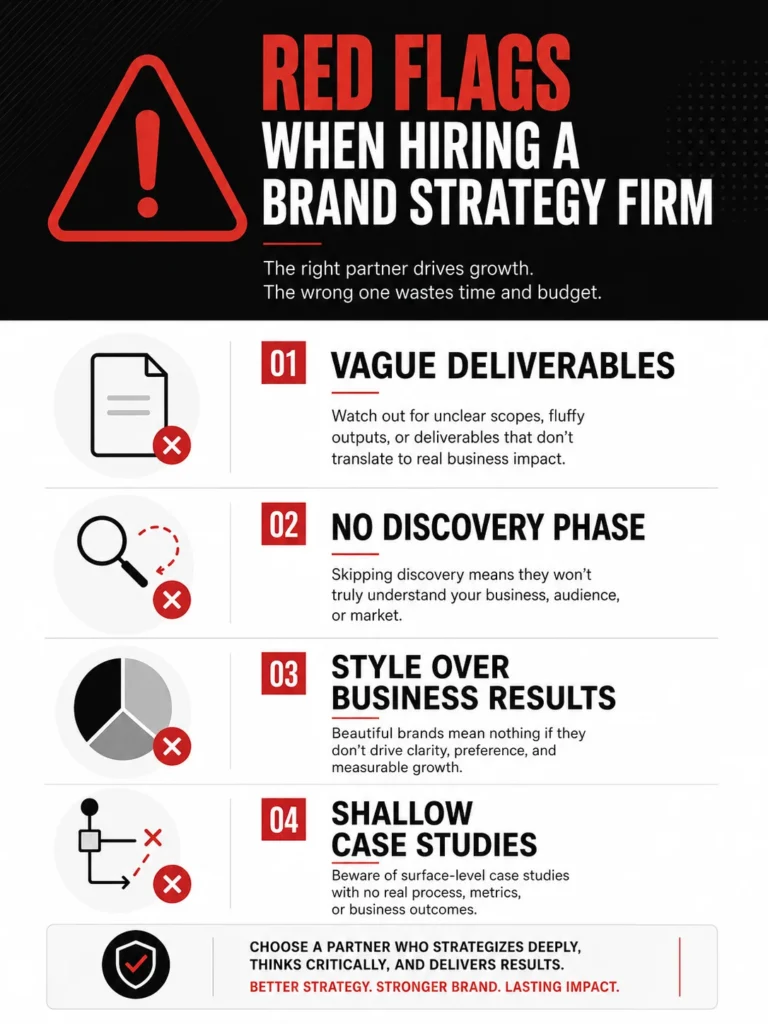
Before you say yes or sign anything, here are the things that should give you pause:
Vague deliverables. When the proposal does not give you specifics regarding what you will get by the end of the project, that can be an issue. “Brand strategy” is not a deliverable. “Positioning platform, messaging framework, identity system” are deliverables.
No discovery phase. If a firm is ready to propose a full scope without spending serious time understanding your business first, they’re probably templating their approach.
All talk about creativity, no talk about business outcomes. Brand strategy exists to drive business results. If a firm can’t connect their work to things like customer acquisition, retention, or competitive differentiation — they may be great at craft but weak on strategy.
Case studies that only show before-and-after visuals. Pretty is easy to sell. Business impact is harder to fake. Push for the story behind the work.
The Types of Firms Out There — And Which One You Need
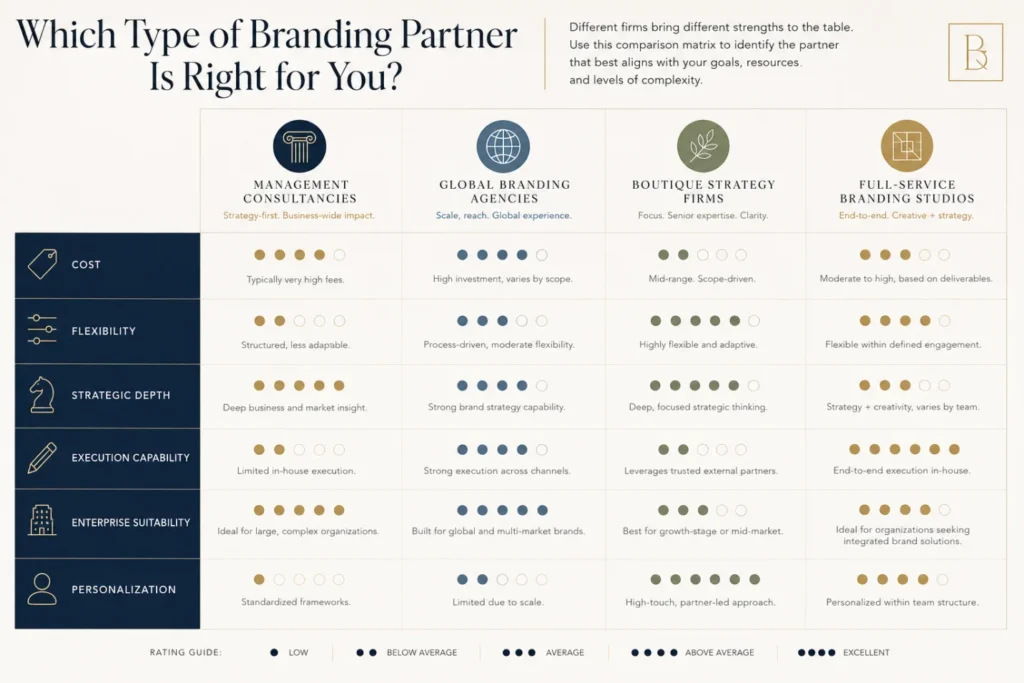
Not all brand strategy consulting firms are built the same. There are roughly four types:
Large management consultancies (McKinsey, BCG, Deloitte): Great for enterprise-level brand architecture tied to major business transformation. Very expensive. Often better at strategy than execution.
Global branding agencies (Interbrand, Landor, Wolff Olins): Strong on both strategy and identity at scale. Typically built for large corporations. Less nimble for mid-market businesses.
Boutique strategy specialists: Focused, senior-led, and usually more accessible. Often the best fit for businesses that want genuine attention rather than being the smallest fish in a big pond.
Full-service branding studios with strategy capability: The sweet spot for many growing businesses — firms that can take you from brand positioning all the way through to identity execution without losing the thread.
If you’re a growing business looking for real strategic input without the overhead of a global consultancy, a focused firm with genuine positioning depth is often the right call. Brandlogg’s brand strategy and planning services are built exactly for this — brands that are serious about where they’re going and want the strategic clarity to get there.
Questions to Ask Before You Hire Anyone
Here’s a practical quick list to bring into any evaluation conversation, like yeah, keep it handy:
- Walk me through a recent engagement — what was the business problem, and what did you specifically recommend?
- How do you approach brand positioning, like what process or frameworks do you use?
- What does your discovery phase look like, and how long does it take?
- How do you measure success at the end of an engagement?
- Who will actually be working on our project — senior strategists, or more junior staff?
- Have you worked with businesses in our category, or at our current stage before?
- What would make us a bad fit for your firm?
That last question is especially telling. The reply usually reveals a lot, about how self-aware and upfront the firm is.
Why Brand Strategy Is Worth Getting Right
Here’s the thing about brand strategy: the cost of getting it wrong doesn’t show up immediately. It shows up in customers who don’t quite understand your value proposition. In sales conversations that never quite land. In a team that can’t consistently articulate what makes you different.
The invisible tax of a weak brand is real — it just gets paid slowly, in a hundred small frictions.
Good brand strategy removes that friction. It gives your business a clear, defensible position in the market. It makes everything downstream — from marketing campaigns to sales collateral to product naming — faster and easier, because everyone is working from the same foundation.
That’s what Brandlogg’s branding services are designed to deliver. Not just a rebrand for the sake of looking fresh — but a strategic repositioning that actually changes how your market thinks about you.
The Bottom Line
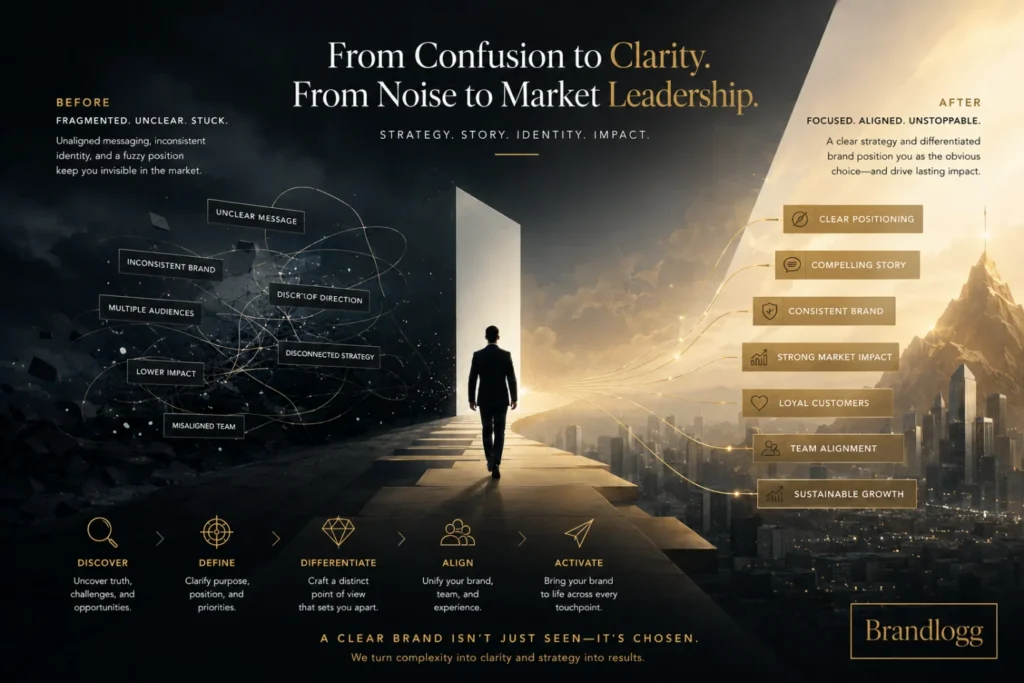
Picking the right brand strategy consulting firm really boils down to a couple of things: genuine strategic depth , not just design talent, a workflow that has real discovery baked in , and case studies that go past the pretty stuff. Also , you want clear , straightforward talk about whether it’s a true fit , and what the expectations actually are.
Don’t hire just because the portfolio looks impressive. Look at how the firm thinks, how they craft the questions, and whether the folks you meet during the pitch are the same ones who’ll be in the room later, shaping your brand day to day.
If you’re still sorting through options , and you want to see how a focused brand strategy engagement plays out — starting with brand positioning and moving through identity — Brandlogg’s brand strategy and planning services are a solid place to start.
The right firm is out there. You just have to know what you’re looking for.