Table of contents
- Social Media Strategy for Small Business: A Step-by-Step Guide That Actually Works
- Why Most Small Business Social Media Strategies Quietly Fail
- Step 1: Set a Goal That's Actually Tied to Money
- Step 2: Build a Persona You Could Actually Picture
- Step 3: Pick Platforms Like a Strategist, Not a Completionist
- Step 4: Use the Hook–Value–CTA Content Framework
- Step 5: Batch Content So You're Never Scrambling
- Step 6: Post on a Rhythm Your Audience Can Set Their Watch To
- Step 7: Layer in Paid Promotion Once Organic Content Is Proven
- Step 8: Track the Three Numbers That Actually Matter
- Mistakes That Quietly Cost Small Businesses the Most
- What This Looks Like in Practice: A Worked Example
- Frequently Asked Questions
- Where to Go From Here
Social Media Strategy for Small Business: A Step-by-Step Guide That Actually Works
Let’s be real about something which most agencies won’t tell you or hide from you: posting on Instagram 3 times in a week is not a strategy. It’s a habit. And honestly following habits without any direction are the reason that why many small business owners spend hours every week creating content that gets 12 likes & 0 sales.
After many years of helping small companies grow, At Brandlogg, we can tell you that it is not just about working hard at it – you are always trying, always posting things. However, what is typically lacking, is the “system” which connects what you post to what you sell.
In this blog guide will give you a real framework which you can use, whether you are just starting your social media journey or have been posting for years but without a plan.
If you’d rather hand this off fully, our Social Media Marketing (SMM) team builds, and also runs, exactly this kind of system for small businesses every day. But if you want to attempt it yourself, first, let’s go ahead and unpack it.
Why Most Small Business Social Media Strategies Quietly Fail
All of the small business accounts we have analyzed till now at Brandlogg has three failure patterns in common:
- The first one is having no clear goal behind the content — posting happens because “we’re supposed to” and not because it’s tied to leads or sales
- The second one is spreading across multiple channels when you should be going deep on only one or two.
- The third one is treating social as a broadcast medium rather than engaging with your audience through comments & DM’s.
If you can fix these issues, then your social media presence will already be far ahead than most small businesses.
According to Constant Contact’s survey of 2026, 68% of small business owners believe that social media posts & paid advertising will provide more value as a sales channel than any other channel. However, the Small Business Expo surveyed and found 67% of owners already consider social media to be critical to generating sales, while many find that what they get from social media is very unpredictable. This gap is exactly what a real plan for social media will help to close.
Step 1: Set a Goal That's Actually Tied to Money
Grow our following” isn’t a goal, it’s a vanity metric. A number of followers doesn’t pay your rent. Before publishing a single piece of content, pick one of the following goals to optimize within 90 days:
- Awareness — get your business in front of a defined number of new local or niche customers
- Leads — drive a specific number of website visits, DMs, or form fills per month
- Sales — generate a target number of direct or social-attributed sales
- Retention — increase repeat purchases, reviews, or referrals from existing customers
Well here’s the part where most guides fails: what your objective is will dictate how you think about changing your content mix, which platforms you prioritize, what times you post. For example, a bakery with a local focus will likely focus on Reels & Stories, while B2B consultants will tend to favour LinkedIn additional case examples. Preparing for two different purposes will result in two completely different playbooks but similar levels of effort.
Step 2: Build a Persona You Could Actually Picture
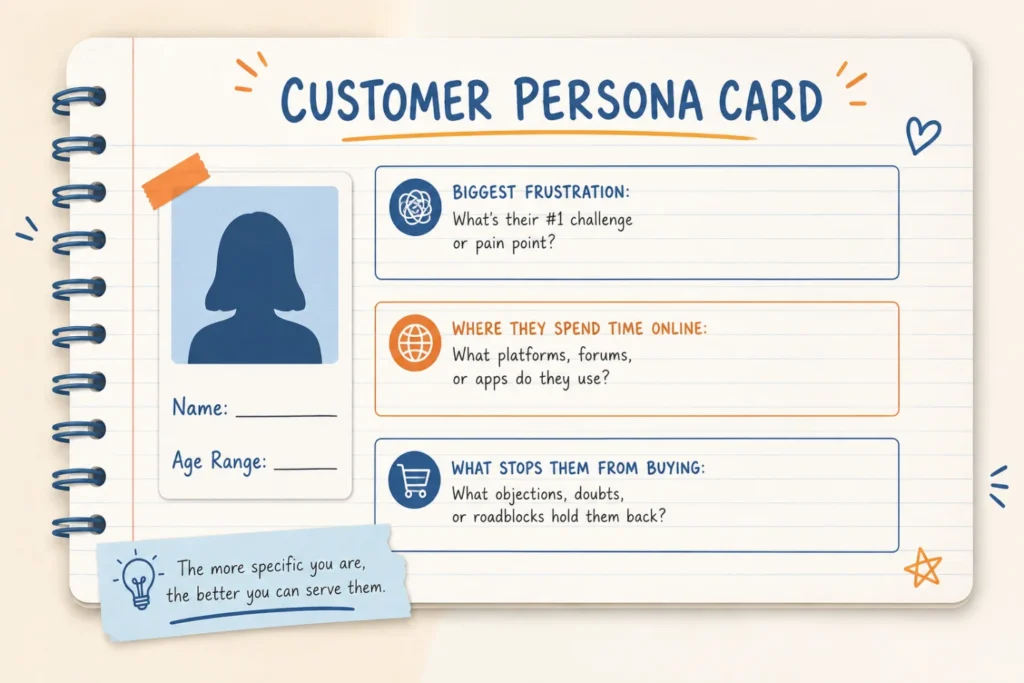
The majority of the “know your audience” advice focuses on age and gender, but what you really need to know is the exact point in time before your customer is about to consider purchasing — e.g., what they are frustrated about, what they have tried to do before, and what is holding them back from purchasing.
To explain this, try writing just one paragraph describing your ideal customer as though you are telling a friend (rather than as a demographic). For example: “Priya has a design firm which has 3 people working. She has grown tired of using the same template repeatedly. She has felt burnt by a hidden-fee design tool and has been trying to find design studios on Instagram that actually share photos of their process at night.”
Your brand voice also plays an important role in determining how you talk to your ideal customer. For example, your tone when talking to Priya will be different from your tone when talking to a first-time budget-oriented buyer. If you have not clearly defined your brand voice, you should consider using our Brand Messaging Services. Building a strong brand voice now will save you time in the future, eliminating the need to redo content after scaling up content creation.
Step 3: Pick Platforms Like a Strategist, Not a Completionist
Well step 3 describes the single biggest mistake that i see: this is trying to be everywhere – Instagram, Facebook, TikTok, LinkedIn, Pinterest & ending up being a mediocre on all 5 instead of strong on most relevant two. Platforms reward depth, not breadth. Pick where your customer actually spends time, not where you assume everyone is.
| Platform | Best For | What Actually Works There |
| Visual products, local businesses, lifestyle brands | use reels for reach, stories for day-to-day relationships, carousel formats for education that can be saved/shared. | |
| Community-based & older crowd with service businesses, | Groups & local event posts will have more impact than feed posts and user reviews build trust. | |
| Business services, consultant or recruiter, thought leadership. | Posts made by the owner regularly get engaged with more than posts made on the company’s page. | |
| TikTok | Brand awareness through younger audiences and trends-driven niches – | Raw/not polished, “quick-cut” video will outperform advertisement with a lot of “polish”; Speak directly to the camera. |
| Product Discovery, Home, DIY, Fashion, Food Niches – | Evergreen pins bring the blog / product page & generate traffic for long-term. |
Rule number one for each & every client: Choose one main platform & one secondary platform. Make sure that you have reached a level where posting becomes a regular habit and is no longer stressful for you, before you start working on your third platform. It is very likely for a majority of small businesses to maintain two platforms with 3-5 hours weekly.
As far as the organic engagement rates go, it varies drastically from platform to platform, and they stand at 5.69% on Tiktok, 0.5%-1% on Instagram business pages, 0.07%-0.15% on Facebook pages & 2%-5% on solid LinkedIn posts. There is nothing to be alarmed about, if you fall short of Tiktok’s average engagement rate; you are competing against your last month’s performance.
Step 4: Use the Hook–Value–CTA Content Framework
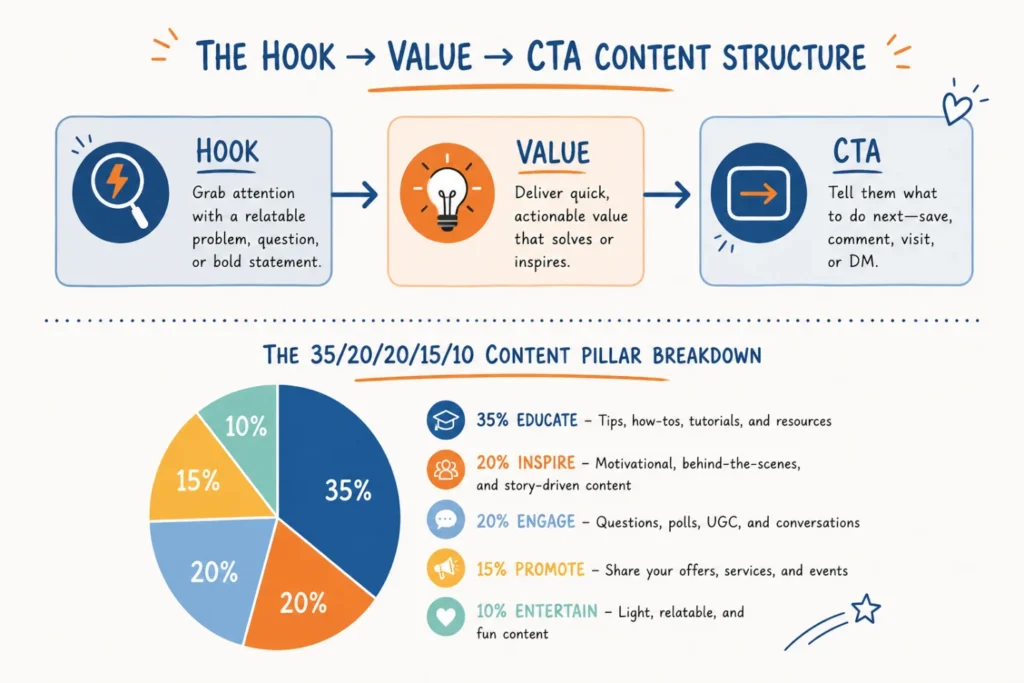
Forget that generic “80/20 rule” advice for a second – that only tells you about the ratio, and not about how to actually write a post that performs. As a social media expert, we at Brandlogg believe that every high-performing post, regardless of platform, follows the same 3 part structure:
- Hook (first 1-2 lines): stops the scroll. A question, a bold claim or a relatable frustration – not your business name.
- Value (the body): the actual tip, story or insight. This is where you earn the follow.
- CTA (the close): one clear next step – comment, save, DM, or click the link in bio. Never more than one ask per post.
Now layer your content pillars on top of this structure so that you are never staring at a blank page again:
- Educational (35%) — provide tips, mistakes to avoid, how-to guides etc. all specific to your industry
- Behind-the-scenes (20%) — show your real process, your team, the reality of running your business
- Social proof (20%) — show real testimonials, reviews, before/afters, user-generated content etc.
- Product/service highlights (15%) — features framed as solutions to specific problems
- Promotional (10%) — offers, launches, direct calls to action
Remember that promotion content should account for 10% and not 20%. It is because we do not want to over promote ourselves considering that at this stage we have not earned much credibility. In addition, this is the type of content production process that can be managed by our Content Marketing services.
Step 5: Batch Content So You're Never Scrambling
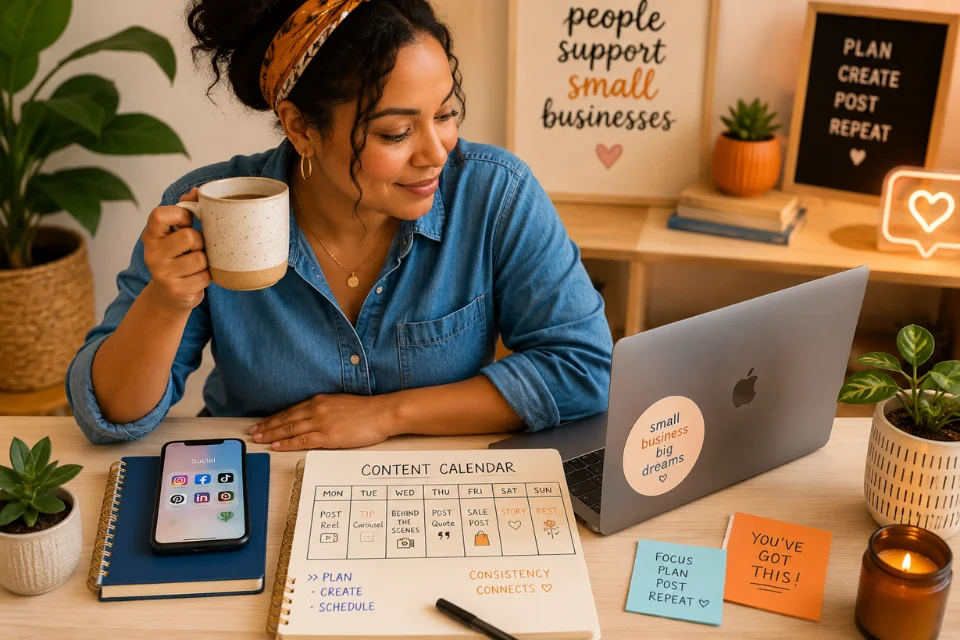
Owners who stay consistent for years, not months , usually don’t create content the same day they post it. They batch it. Like, set aside one 2-3 hour block every two weeks, and just shoot 8-10 pieces of content, write the captions in one sitting, then schedule everything with a free or low-cost tool like Buffer, Later, or Meta Business Suite. That one change – going from daily creation to biweekly batching—really is what makes social media feel like constant stress vs something predictable that just lands in your week.
For design, Canva still feels like the quickest path to on-brand graphics without needing a designer & for quick video, CapCut will handle trimming, captions, and that trending audio stuff in minutes. Also keep a running swipe file—post ideas, plus the customer questions you keep hearing—so batching day doesn’t start from a blank page, ever.
Step 6: Post on a Rhythm Your Audience Can Set Their Watch To
Platform algorithms favor accounts that post consistently over accounts that post often. A realistic, sustainable rhythm for a small team:
- Primary platform: 4-5 posts per week, including at least 2 Reels/Stories or short-form video
- Secondary platform: 2-3 posts per week
- Engagement (comments, DMs, community interaction): 15-20 minutes, every single day
That last bullet is the one almost everyone skips, and it’s arguably the most important — algorithms read engagement as a signal your account deserves more reach. Responding within the first hour after posting noticeably increases how far that post travels. Treat replies as part of the strategy, not an afterthought
Step 7: Layer in Paid Promotion Once Organic Content Is Proven
Organic content tells you what resonates; paid budget tells you how far you can scale it. Don’t fund content you haven’t validated. Watch your organic posts for two weeks, find the one or two that clearly outperformed in saves, shares, or comments, and put a small, targeted budget behind those.
Even $10-15 a day aimed at a tightly defined audience — people who match the persona you built in Step 2 — will consistently outperform a bigger budget aimed at “everyone in my city.” Boosting an already-proven post is a quick way to extend reach; a structured campaign with proper targeting, multiple creatives, and conversion tracking is what actually drives leads and sales at scale. If you’re ready for the second one, that’s precisely what our Social Media Advertising team handles — audience targeting, creative testing, and budget optimization so every dollar is working, not guessing
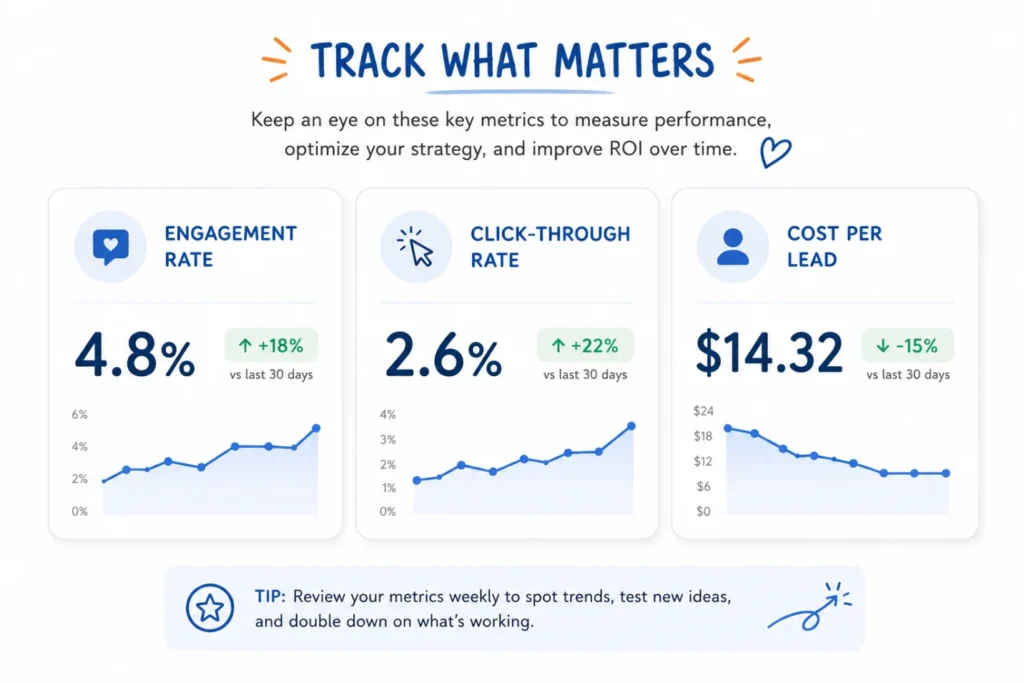
Step 8: Track the Three Numbers That Actually Matter
Ignore vanity metrics. Every month, look at just three numbers:
- Engagement rate (engagement ÷ reach) — tells you if your content is actually resonating, not just being seen
- Click-through rate to your website or DMs — tells you if your content is converting interest into action
- Cost per lead or sale (if running ads) — tells you if the spend is actually profitable
Use this simple formula to judge real return:
Social Media ROI = (Revenue Attributed to Social – Total Cost) ÷ Total Cost × 100
If you spent $300 last month on tools and ads and generated $1,800 in attributable revenue, that’s a 500% return. Review this monthly, not daily — social media results compound over weeks, and checking obsessively just leads to chasing noise instead of trends.
Mistakes That Quietly Cost Small Businesses the Most
Here are the common mistakes that most small businesses make:
- The first one is posting content regularly for the first 2 weeks and then going silent for a month & wondering why reach dropped
- The second one is writing captions for everyone instead of the one persona who actually buys
- The third one is deleting the underperforming posts instead of studying that why they are not working
- The next up is running ads with no clear offer or landing page, just “more visibility”
- The last one is comparing your account to the large and well-established brands with budgets & teams which you don’t have right now
What This Looks Like in Practice: A Worked Example
An illustrative example of the framework applied:
A home services business (residential cleaning/landscaping) was posting on three platforms inconsistently, averaging 2 posts a week with almost no engagement. Applying this framework over 90 days:
- Cut from three platforms to one primary (Facebook, where their local customers actually were) and one secondary (Instagram)
- Shifted to the 35/20/20/15/10 pillar mix, leading with before/after job photos as social proof
- Batched content biweekly instead of posting reactively, cutting weekly time from ~6 hours to ~2
- Put $15/day behind the best-performing organic posts after week 3
Result: engagement rose from under 0.3% to roughly 2.1% by day 90, monthly website clicks grew from ~40 to over 300, and the business attributed 14 booked jobs directly to social in month three, at a customer acquisition cost roughly 60% lower than their prior paid search spend. Illustrative of typical outcomes, not a guarantee — results depend on your offer, market, and starting point.
Frequently Asked Questions
Most of the small businesses can start with $0 in ad spend & can focus on grow organically for the first 60-90 days, once you found out the content that is working for you then you can spend $200-500/month in paid promotion. After that you can scale your spend based on your ROI.
You should post for 3-5 times a week on your chosen platform to maintain sustainability. A consistent 4 posts a week for six months usually beats the chaotic “10 posts a week for three weeks” thing, because burnout is real, and your audience can feel that
Always pick the one where your specific customer persona already hangs around the most. Not the one that’s trending today or whatever is shiny on a list. Use the platform table above as your first filter, then commit.
Measurable increases in engagement should occur after about 30-45 days, while substantial increases in leads and/or sales should be seen after about 90-120 days. Businesses that did not continue their efforts beyond 3 weeks never realize any benefits typically gained around week 12.
Yes you do need one. Even a basic excel sheet for your next 30 days helps you avoid the biggest failure mode: inconsistency, from scrambling for ideas right when it’s time to post
Sources
Constant Contact, Small Business Now: Small Businesses Double Down for 2026 (Jan 2026) •Small Business Expo Research Desk, 2026 •Sprout Social, Social Media Statistics (2026) •Socioapt, Social Media Marketing Statistics for Small Businesses (2026) •HubSpot, State of Marketing Report (2026)
Where to Go From Here
None of the above mentioned strategy requires a big budget or a marketing degree – the all it needs is a systematic process that is consistent & runs for much longer time than most people can stand. Set one clear goal, know your target audience exactly, first focus on only 1-2 platforms and go deep into it, post content that is built around Hook-Value-CTA framework & track 3 numbers monthly.
That’s the whole game.
Social media is not meant to exist on its own; it is most effective when supported by your SEO writing for your website, your email list and your overall brand presence. If you would like help mapping out the bigger picture, then our digital marketing services will tie together all of your channels into one cohesive strategy rather than seeing them as separate strategies.
If having a professional team create, batch and implement (e.g., content creating, post frequency, engaging with followers, purchasing ads) this system for you appeals to you — then our Social Media Marketing (SMM) services are precisely what you require. Let’s design a plan that meets your company’s requirements.