Table of contents
- Signs It's Time and How to Do It Right
- Signs It's Time to Rebrand
- Rebrand or Refresh? Know the Difference First
- When Not to Rebrand
- Real-World Rebranding Examples
- The Rebranding Process, Step by Step
- Common Rebranding Mistakes
- How Much Does Rebranding Cost?
- Frequently Asked Questions
- Where to Go From Here
Rebranding Checklist: Signs It's Time and How to Do It Right

Every successful business sooner or later faces the following dilemma: does the brand still represent who they are?
Sometimes the answer is clear. A logo looks out of date. The business has moved into something new and the old name feels off. Other times, the urge to change comes from stress, not from reality.
However, the urge to rebrand is not always valid. There are many companies that invest months into redesigning their logos because they misunderstood the problem and should have considered positioning instead. Or they postpone rebranding because of fears and end up missing a great opportunity to grow further.
This guide explains when you should definitely do the rebrand, when to wait, and how to do it right.
Key Takeaways
- A rebranding must address a market issue – a positioning that has become obsolete, a tarnished reputation, a confused market – not just internal dissatisfaction with a logo.
- A brand refresh keeps the existing brand equity, making it quicker and cheaper than a complete rebrand.
- Most of the lost organic traffic during a rebranding is due to bad redirects and poor metadata planning, not the new brand.
- Most companies that benefit the most from a rebranding treat it as a strategy project first, and then as a design project.
Signs It's Time to Rebrand
Not every itch to redesign a logo is a real signal. Below are the ones worth taking seriously, grouped by where they usually come from.
Signs Rooted in the Business Itself
The business has outgrown what the brand describes. This is the most common trigger. A company that started as a local bakery is now a packaged foods brand sold in three states. A tool that began as a scheduling app now does five other things. When the name, visuals, or messaging describe a business that no longer exists, customers feel the disconnect even if they can’t articulate it.
The business is entering a fundamentally different market. Shifting from consumer to B2B, or from a mass-market play to a premium one, usually requires a brand that can carry a different kind of trust. The visual language that works for a budget-friendly audience rarely convinces an enterprise buyer, and vice versa. This is exactly where a brand positioning exercise earns its cost back.
There’s a reputation problem incremental changes won’t fix. A quality crisis, a leadership scandal, or a public failure so significant that the current brand carries baggage that’s hard to talk away. This is one of the few cases where a full identity change — not just a marketing campaign — is genuinely the right call.
A merger or acquisition left two brand systems running in parallel. Plenty of companies limp along for years with two logos, two color palettes, and two tones of voice because nobody wants to make the call. It fragments trust and confuses everyone, including the internal team.
Signs Rooted in Perception
The visuals are dated in a way that undermines credibility. There’s a difference between a brand that feels classic and one that feels stuck. If a website or packaging makes people wonder whether the business is even still operating, that’s no longer a style preference problem.
Customers keep mistaking the brand for a competitor. When customers, investors, or job candidates genuinely confuse a company with someone else in its space, differentiation has failed at the most basic level — visibility.
The positioning has moved, but nothing else has caught up. Maybe the business used to compete on price and now it competes on craftsmanship. If the brand still whispers “budget option” while the product has moved upmarket, the brand messaging is actively working against the strategy.
The brand is attracting the wrong customers. If a business consistently gets inquiries that don’t fit — wrong budget, wrong expectations, wrong fit — the brand may be signaling something it doesn’t actually offer anymore.
A Quick Gut-Check
Pull up the website and ask honestly: does this still feel like us? Would the team be proud to hand this to a new customer today? Hesitation is usually the answer.
Counted three or more signs on this list? That’s usually the point where it’s worth getting an outside opinion before spending on design work. Talk to Brandlogg’s brand strategy team for an honest read on whether it’s time for a refresh or a full rebrand.
Rebrand or Refresh? Know the Difference First
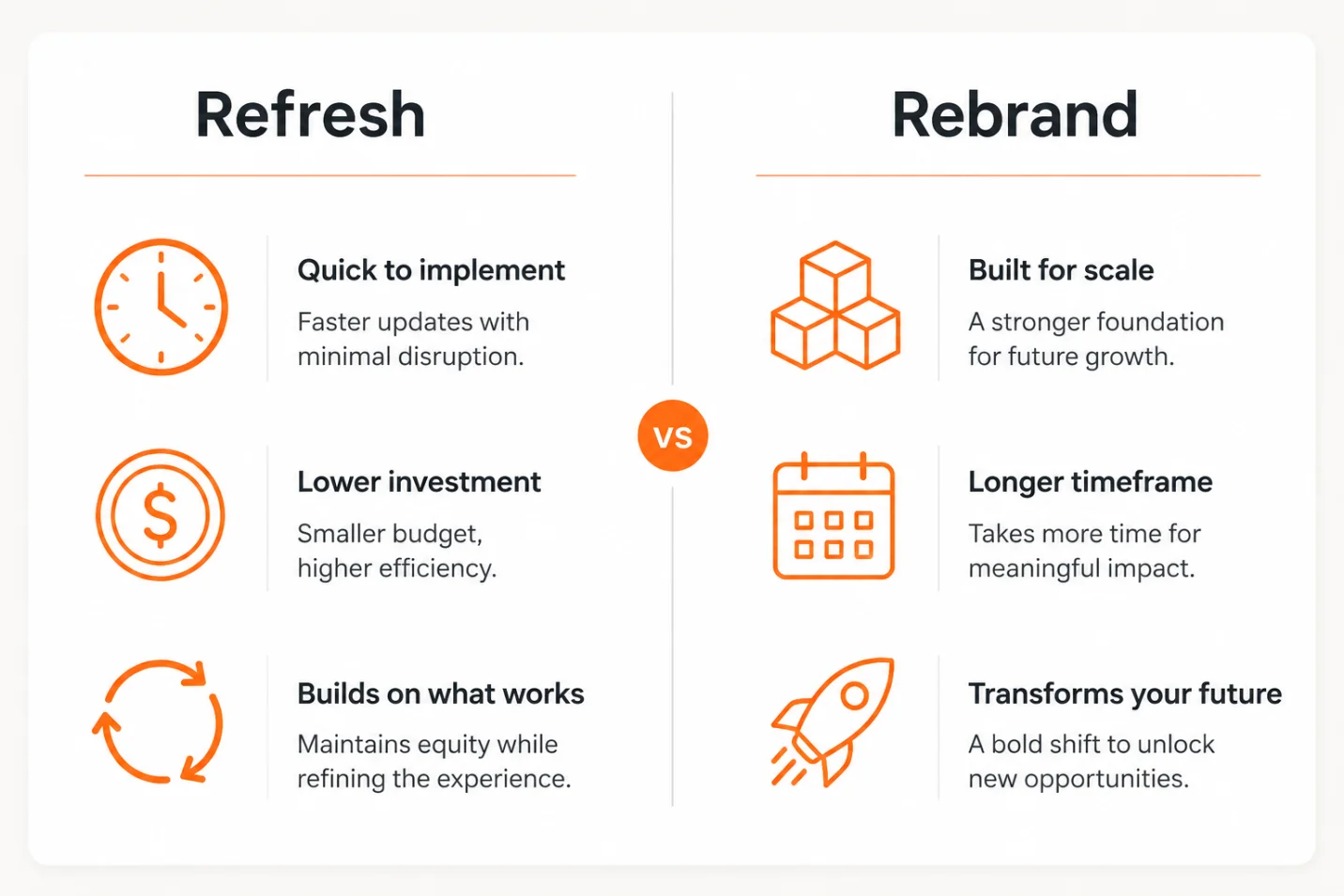
Well this is the step which most of the businesses skip, and it’s the one that saves the most money.
What a Brand Refresh Covers
The brand refresh focuses on changing the look, refining the logo, updating the color scheme, adjusting the messaging, while still preserving all the recognition equity that was developed over time. The brand refresh process is quicker, easier, and safer. In addition, it is usually the right choice in most cases.
What a Full Rebrand Covers
A full rebrand rebuilds the identity system from the ground up – sometimes including the name itself. It’s a bigger undertaking, takes real time, and should be reserved for situations where the underlying business, audience, or positioning has genuinely changed, not just the way it looks.
Dunkin’ Donuts is a good example of getting that balance right — more on that below.
The One Question That Settles It
What percentage of the problem would a refresh actually solve? If the answer is “most of it,” that’s usually enough to skip a much longer, more expensive process.
When Not to Rebrand
A brand refresh must address a market challenge, not an internal one – and this bears repeating before any money is allocated.
It doesn’t make sense for a company to rebrand itself because the staff is sick of the logo or the competition just introduced some exciting visuals. There is a tendency to mistake looking new for being new. A fresh look added to the same lackluster positioning will just make confusion look better.
It makes sense to determine in advance how much not changing will cost. If the existing brand isn’t hurting customer acquisition, income, or the company’s credibility, then maybe the issue only exists internally.
Real-World Rebranding Examples
Theory is easier to trust with real examples attached. Here are four that show both ends of the outcome spectrum.
1. Dunkin' Donuts → Dunkin' (2019): A Rebrand Done Right
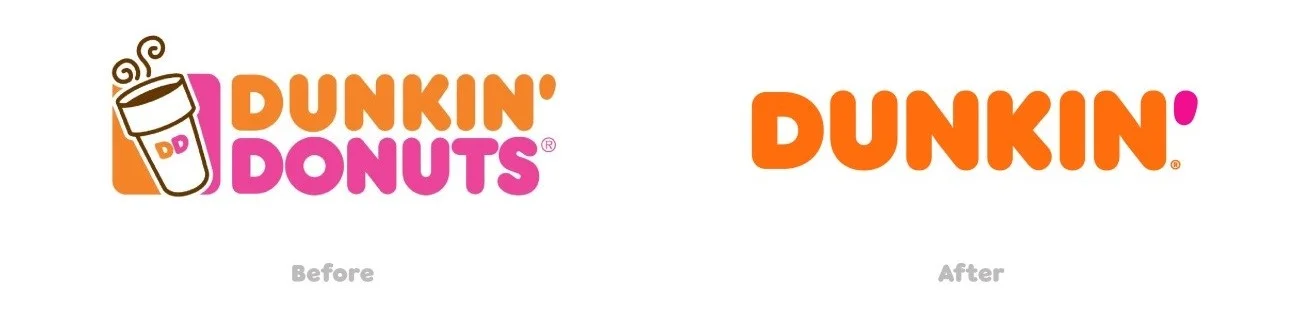
The world famous fast food restaurant Dunkin’ Donuts shortened its name by removing Donuts to reflect its shift toward beverages while keeping its familiar colors and typography.
Lesson: Change what no longer fits, but always protect what your customers already recognize.
2. Tropicana's 2009 Packaging Redesign: A Rebrand Done Wrong
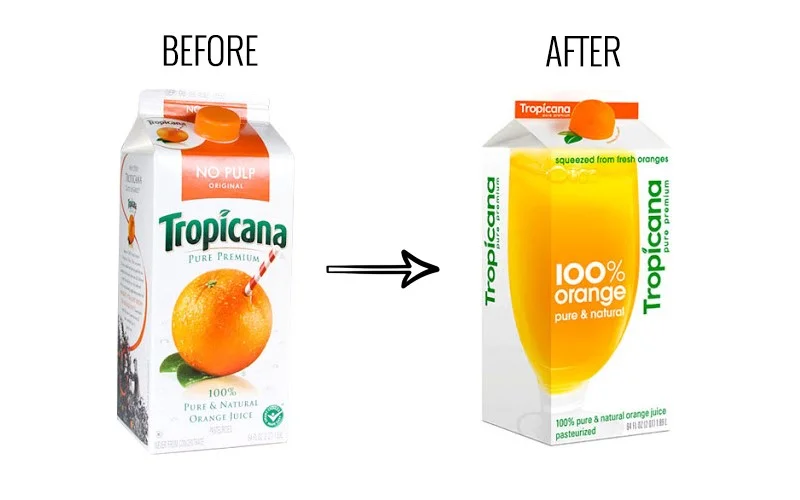
Tropicana, fruit-based beverages brand done a new packaging redesign in 2009 which made the brand harder to recognize, contributing to an estimated 20% sales drop. Tropicana quickly returned to the original design.
Lesson: Don’t underestimate the value of existing brand recognition.
3. Gap's 2010 Logo Change: A Six-Day Rebrand
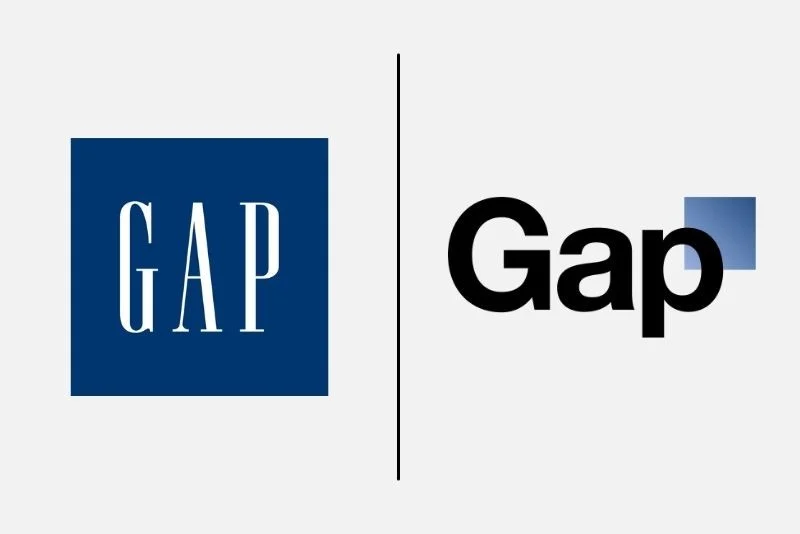
An American based clothing brand Gap replaced its iconic logo in 2010 without clear strategic reasoning or customer testing. After facing a strong backlash and 100$ million loss it restored the original logo just six days later.
Lesson: Visual changes need a clear strategic purpose.
4. Airbnb's 2014 Rebrand: Betting on Strategy Over Aesthetics
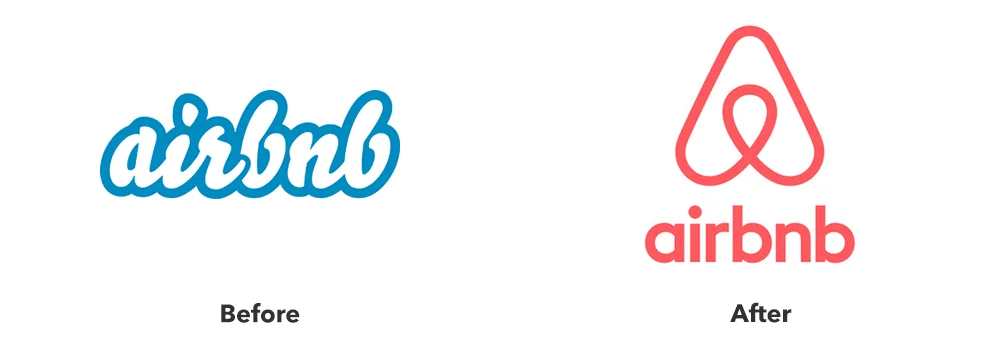
Airbnb introduced its Bélo symbol as part of a broader shift toward “belonging anywhere.” Despite mixed initial reactions, the rebrand supported its global growth.
Lesson: Strong strategy can make a rebrand successful even when initial reactions are mixed.
The Rebranding Process, Step by Step
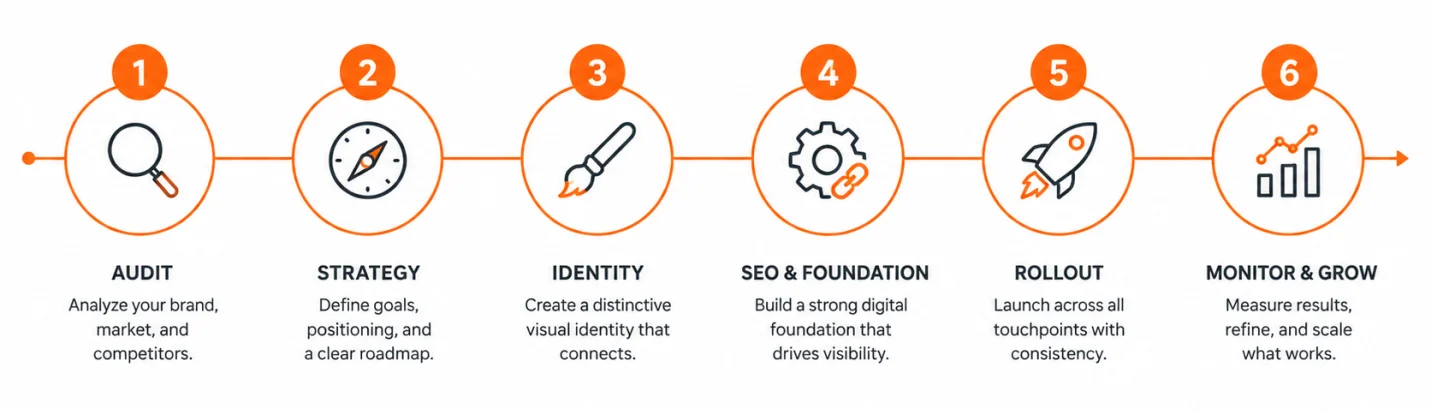
Once the need is confirmed, here’s how the work typically breaks down.
1. Strategic Audit
Before anyone touches a design tool, it’s worth figuring out what’s actually broken. This means talking to customers, employees, and stakeholders – not just informally, but through structured interviews and surveys.
It also means mapping competitors’ visual and verbal landscape to understand what “different” actually looks like in the category. Most importantly, this stage diagnoses whether the real issue is strategic, visual, or simply inconsistency across existing touchpoints.
This is usually where a formal brand strategy and planning engagement starts, because guessing at the diagnosis is how budgets get wasted later.
2. Strategy & Positioning
This is where a business defines who it’s becoming, not just what it will look like. That means locking in new brand positioning, the target audience, and — critically — the scope of the project.
Is this a full overhaul, a partial refresh, or purely a visual update? If the business has changed enough that the old name no longer fits, this is also the point to seriously evaluate brand naming.
A realistic budget and timeline should be set before design work starts, not after.
3. Identity Design
Now the visual and verbal system comes together: logo, color palette, typography, imagery style, and brand voice. Good identity design needs to work everywhere — a favicon and a billboard are very different tests for the same logo.
This is also where a proper brand style guide gets documented, so the identity stays consistent long after launch, regardless of who’s executing it.
4. SEO Migration Planning
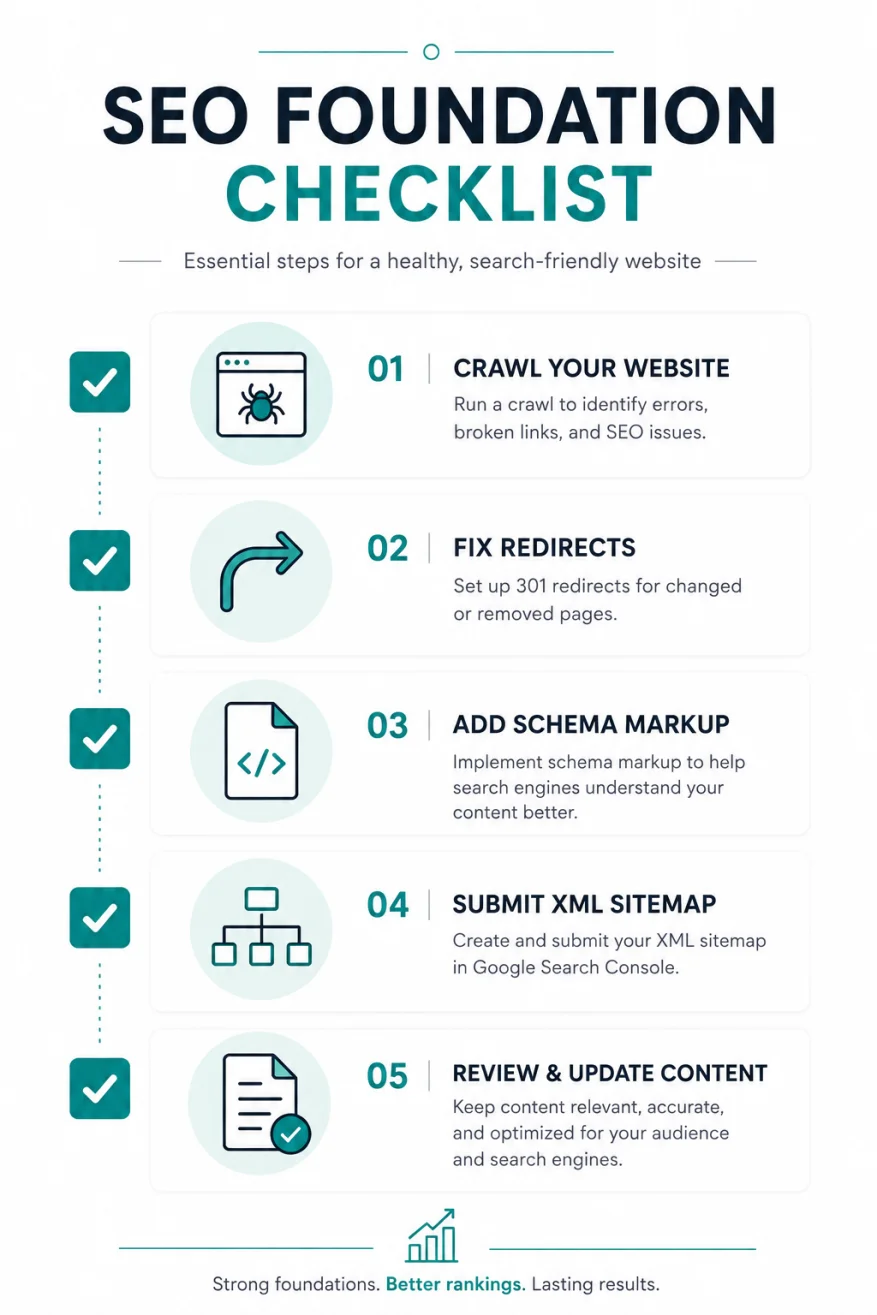
This is the step agencies love to skip and businesses regret skipping. If a rebrand touches the domain, URLs, or site structure, SEO migration deserves its own workstream, not an afterthought.
That means:
- Crawling the existing site and exporting top-performing URLs, rankings, and backlink data before anything changes
- Building a clean, one-to-one redirect map — no chains, no loops
- Updating schema, metadata, and internal linking to point at the new structure from day one
Rebrands that lose organic traffic almost always lose it here, not in the design. Pairing this phase with an actual SEO team rather than leaving it to the design agency is one of the biggest differences between rebrands that keep their traffic and ones that don’t.
5. Rollout Across Touchpoints
Every place the brand lives — website, social profiles, packaging, signage, email templates, sales materials — needs a realistic sequence for updating.
The website and any marketing materials are usually the highest-visibility touchpoints, so it makes sense to sequence those early. Trying to switch everything simultaneously tends to create more chaos than a phased rollout does.
6. Launch & Monitoring
A team should understand and believe in the new brand before customers ever see it. They’re the first ambassadors, and an internal team that’s confused or unconvinced will undercut the whole effort.
On external launch day, the announcement should lead with the why behind the change, not just the what — framing it as evolution rather than a rejection of everything that came before.
From there, rankings, traffic, conversions, and sentiment are worth tracking closely for at least the first 90 days. That’s where problems get caught while they’re still small.
Common Rebranding Mistakes
The same failures tend to repeat themselves across most rebrands that don’t work out:
- Rebranding to fix an internal problem, not a market one. If the team is the only one tired of the brand, that’s not a market signal.
- Treating it as a design project instead of a strategic one. The logo should be the last decision, not the first.
- Skipping customer testing. Assuming how an audience will react is how good brands get replaced with confusing ones – Gap’s 2010 logo change is the textbook case.
- Ignoring existing brand equity. Years of recognition are an asset. Tropicana’s 2009 packaging redesign shows how quickly that asset can be lost.
- Neglecting SEO migration. This alone has cost otherwise well-executed rebrands months of lost visibility.
- Hesitant execution. A half-committed rollout – old and new branding coexisting for months – confuses an audience more than either brand alone would.
How Much Does Rebranding Cost?
Costs vary enormously depending on scope, so it’s worth treating any number seen online with some skepticism – including precise-looking ones.
- Small Business: Small business branding projects generally need less time and money because they address less complex issues.
- Mid-Sized Business: Mid-size business branding projects often take months to implement and need substantial investment.
- Enterprise: The enterprise level branding projects are the most complex & expensive ones. They may require more than a year for implementation and the involvement of numerous specializations.
The best way to answer this question is with an estimated cost, scoped to the specific business case rather than to a figure cited on a blog post – including this one. To provide a single figure, rather than a range, request a quote that scopes specifically to your business, rather than a general model.
Frequently Asked Questions
Where to Go From Here
A rebrand which is done very well does not just change how a business looks – it clarifies who it is, for both the team and for the customers as well. But the only time it works is when the strategy comes before the design & execution is treated as seriously as the creative.
For businesses who are seeing several of the signs mentioned above and still unsure whether it needs a refresh or a full rebrand, that’s exactly the kind of question worth a second opinion before spending on design work. Brandlogg’s team has served businesses across industries like food, healthcare, retail & professional services and helps them in many ways from strategy and positioning through identity design, style guides & SEO groundwork that protects traffic through the transition.
Still not sure where your business stands? Book a free brand audit with Brandlogg’s strategy team for a straight answer on whether it needs a refresh, a full rebrand or nothing at all.

