Table of contents
- How Global Brands Are Leveraging AI for Speed, Scale, and Smarter Results
- AI Marketing Trends & Statistics to Know in 2025–2026
- Examples of Artificial Intelligence in Marketing
- How to Start Using AI in Marketing (Step-by-Step)
- 5 Common AI Marketing Mistakes to Avoid
- Top AI Marketing Tools for 2025–2026
- What’s Next: The Future of AI in Marketing (2026 and Beyond)
- Which AI Tactic is Right for You?
- Brandlogg: A Trusted Leader in AI-Powered Marketing
- Final Thoughts: Marketing’s Future Has Already Arrived
15 Examples of Artificial Intelligence in Marketing (2025-2026 Edition)
How Global Brands Are Leveraging AI for Speed, Scale, and Smarter Results
In the year 2025, marketing has officially evolved beyond the days of gut instinct and generic campaigns. Now we have entered the age of Artificial Intelligence (AI) — where marketing is driven by data, powered by automation & personalized like never before.
AI is no longer just a buzzword tossed around in boardrooms or startup pitches. It’s a non-negotiable driver of ROI.
According to the recent studies:
- 72% of marketers now use AI daily (Gartner, 2025)
- Campaigns powered by AI are seeing 3x more ROI compared to traditional ones (McKinsey)
- 90% of top-performing brands cite AI as a core part of their competitive advantage (Forrester)
From automating content creation to predicting behavior of customers, AI is now at the heart of modern marketing innovation.
In this blog, we will look at 15 compelling real-world examples of how brands are using AI across channels, across industries, and how your business can do the same.
So let’s dive in.
AI Marketing Trends & Statistics to Know in 2025–2026
Before we get into specific use cases, let’s zoom out. What’s the bigger picture of AI in marketing right now?
| Trend | Insight |
| AI Adoption | 85% of marketing teams have integrated at least one AI tool (Statista, 2025) |
| ROI Impact | AI-driven personalization leads to a 40% increase in customer lifetime value (PwC) |
| Content Creation | AI generates 45% of marketing content in medium to large enterprises (Accenture) |
| Top Tools | Jasper, ChatGPT, Persado, Synthesia, and Salesforce Einstein top the 2025 AI tool charts |
Key Takeaway: AI is no longer “coming soon” — it’s already delivering value, and brands not leveraging it risk falling behind.
Examples of Artificial Intelligence in Marketing -
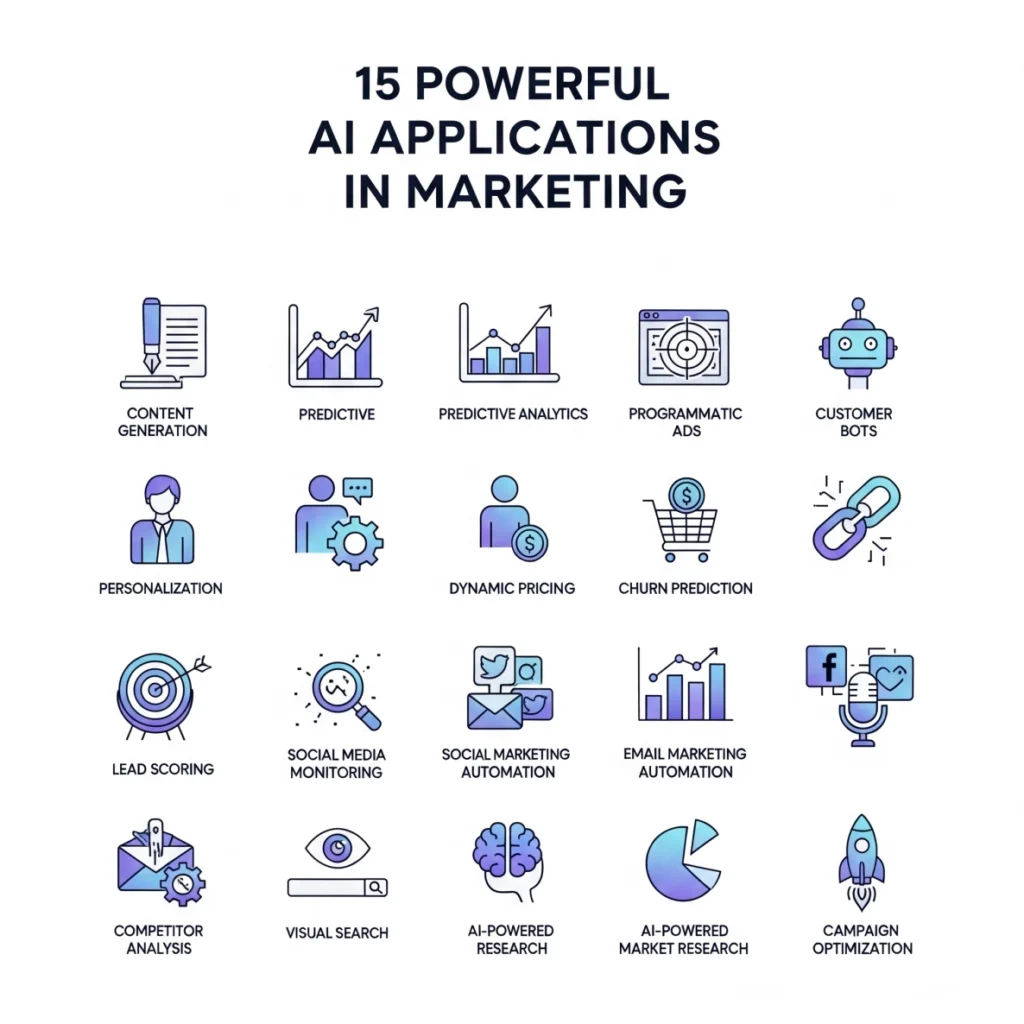
1. AI-Powered Content Generation: From Draft to Done in Seconds
What is It:
Imagine if your blog posts, product descriptions & social media captions could write themselves and that too perfectly on-brand & SEO-optimized. That’s exactly what AI tools like ChatGPT, Jasper & Copy.ai make possible.
Real-World Example:
- HubSpot is now using AI to generate blog outlines, meta descriptions, and first drafts – taking the blog production time to 60% less time.
- BuzzFeed is leveraging AI to automate quiz and listicle generation to keep pace in high-volume content production cycles.
- The Guardian publishes automated financial updates using AI-generated news templates, specifically when the market is moving quickly!
Benefits:
- Content creation is now 10x faster
- Brands can scale output without scaling headcount
- Localized or multilingual content is just a few prompts away
2. Predictive Analytics: Your AI-Powered Crystal Ball
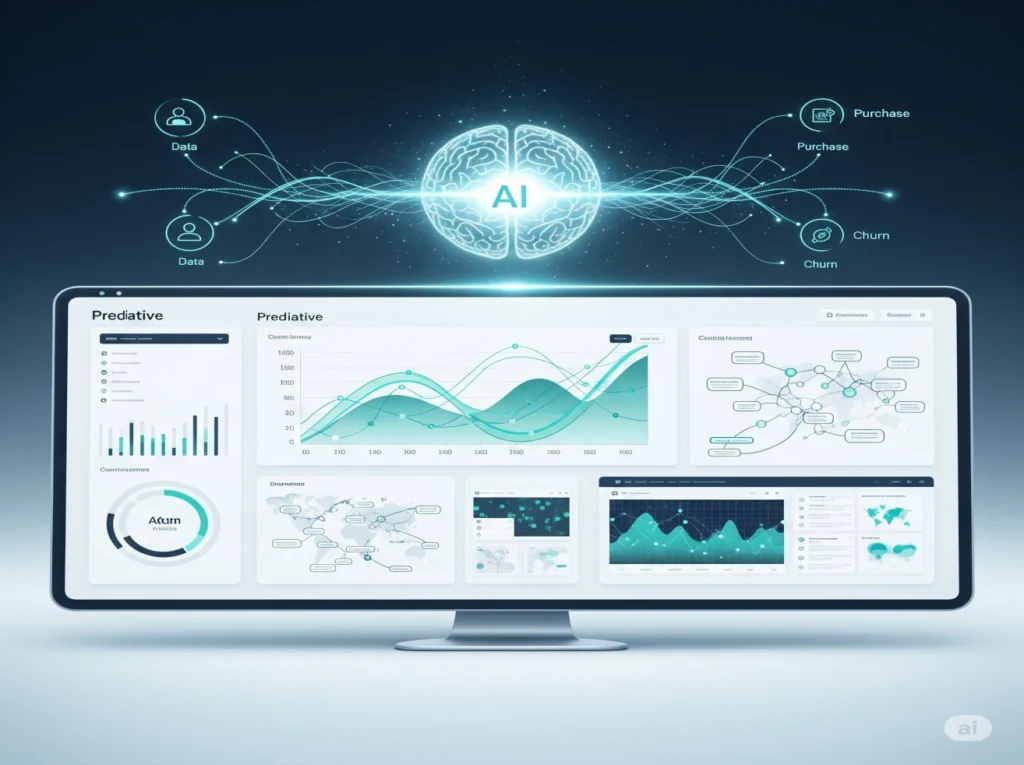
What It Is:
Predictive analytics uses machine learning to forecast what customers might do next — whether it’s purchasing a product, leaving a service, or clicking an email.
Real-World Example:
- Amazon drives nearly 35% of its revenue through AI-powered product recommendations.
- Netflix saves over $1 billion annually by predicting user behavior, reducing churn, and personalizing viewing experiences.
Benefits:
- Marketing teams can predict outcomes before they occur
- Ads are better timed and targeted
- Businesses gain higher lifetime value per customer
3. Programmatic Advertising: AI That Buys Better
What It Is:
Gone are the days of static ad placements and manual media buying. Programmatic advertising lets AI buy and place ads in real-time, optimizing budgets and performance dynamically.
Real-World Example:
- Coca-Cola used AI to tailor ad creatives based on local sentiment, increasing click-through rates by 22%.
- Nike deploys programmatic tools to promote excess inventory — targeting the right demographics at the right time.
Benefits:
- Improved ROAS (Return on Ad Spend)
- Lowered media wastage
- Real-time bidding and creative swaps
4. Hyper-Personalized Email Campaigns: Inbox Engagement, Reimagined
What It Is:
AI now powers personalized email experiences that feel tailor-made — from subject lines to product recommendations, content blocks, and timing.
Real-World Example:
- Sephora sends beauty tips and product recommendations personalized by skin tone and past purchases — lifting conversions by 25%.
- Spotify delivers curated playlists and podcasts directly to users’ inboxes based on listening behavior.
Benefits:
- 30–50% higher open and click-through rates
- Fewer unsubscribes
- Stronger emotional connection with recipients
5. Conversational AI: Chatbots That Actually Convert
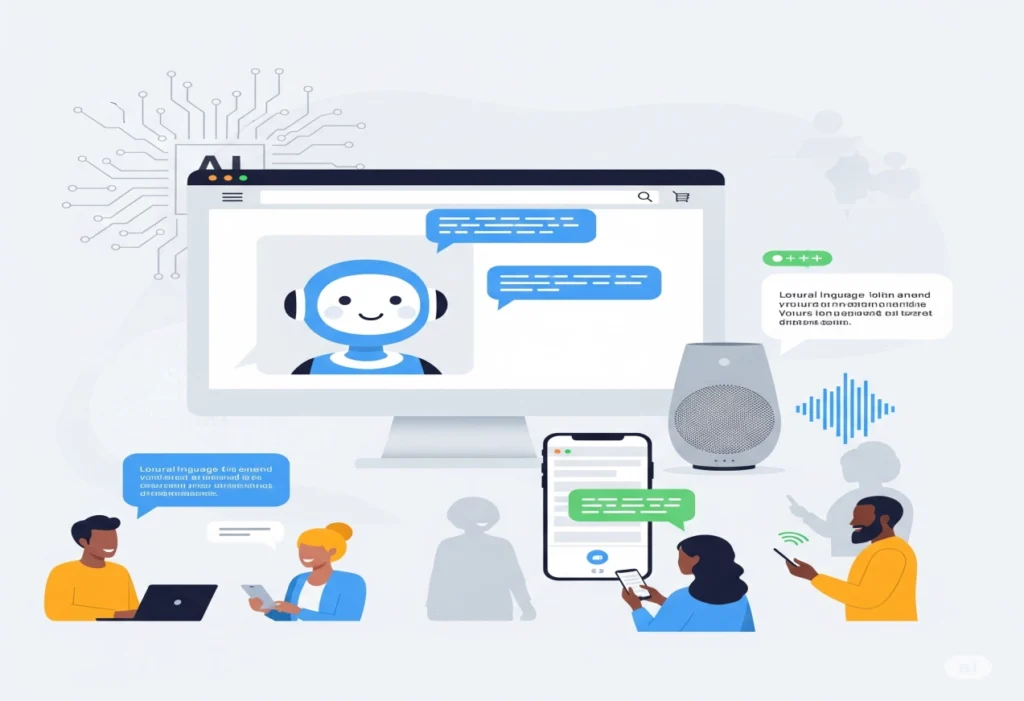
What It Is:
Modern chatbots do more than answer FAQs. They qualify leads, upsell products, handle support, and even place orders — all while learning and improving over time.
Real-World Example:
- Domino’s now processes over $1 billion in voice-based orders annually via its AI assistant.
- HDFC Bank’s chatbot, EVA, handles over 5 million customer queries every month.
Benefits:
- Instant, 24/7 customer service
- Higher lead conversion
- Lower cost per interaction
- 2x higher lead conversion compared to traditional forms
6. Visual Recognition: AI That Sees and Sells
What It Is:
AI can now “see” and understand images — identifying faces, logos, and even emotions. Marketers use it to improve product discoverability, monitor brand mentions, and offer augmented experiences.
Real-World Use:
- Pinterest Lens enables users to search for products with images — powering 600M+ monthly visual queries.
- Gucci’s AR filters on Snapchat allow virtual try-ons — increasing in-app sales by 11%.
Benefits:
- Deeper social and mobile engagement
- Influencer & UGC tracking at scale
- AR-based conversion boosts
7. AI Copywriting: Emotion-Based Ad Content at Scale
What It Is:
AI tools like Persado and Google’s Smart Ads generate ad variations tailored to emotions, behaviors, and A/B results — delivering copy that converts, not just communicates.
Real-World Use:
- American Express boosted conversions by 30% with emotionally optimized call-to-actions from Persado.
- Google’s responsive ad formats automatically test and display the best-performing combinations.
Benefits:
- Real-time A/B testing
- Personalized copywriting
- Campaigns fine-tuned by data, not guesswork
8. Dynamic Website Personalization
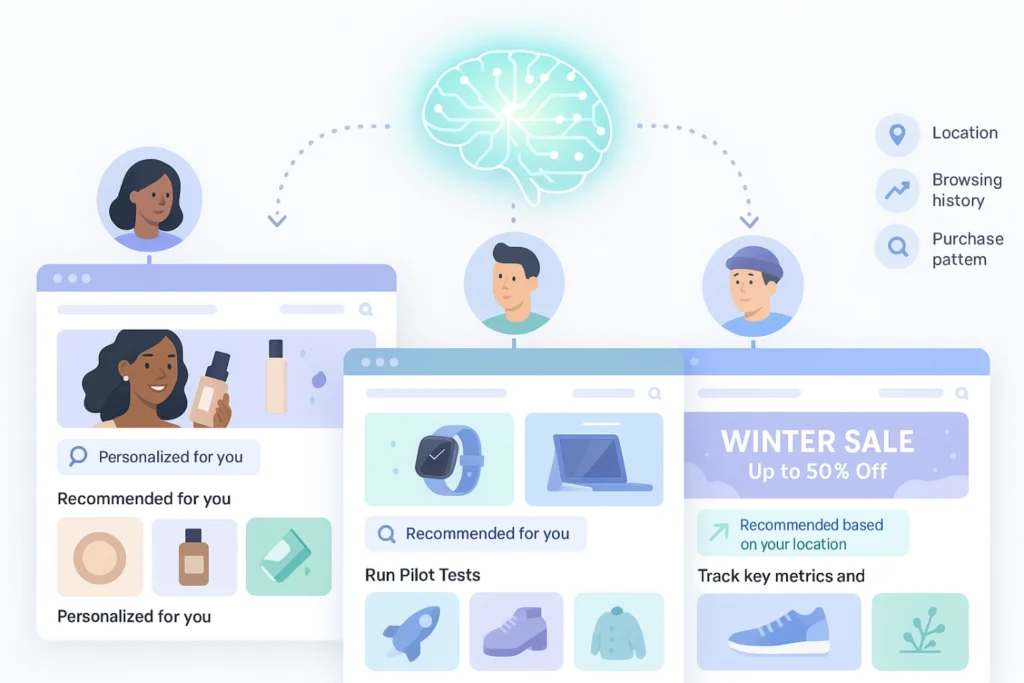
What It Is:
Why show every visitor the same homepage? AI enables brands to show different layouts, banners, and product suggestions to each user based on behavior and context.
Real-World Use:
- Amazon personalizes nearly every aspect of its site in real-time, enhancing retention.
- Nykaa adjusts product recommendations based on skin tone, season, and browsing patterns.
Benefits:
- Increased dwell time
- Lower bounce rates
- 2–3x higher conversions from repeat visitors
9. Voice Search Optimization: Speak to Be Found
What It Is:
AI understands natural speech, enabling brands to rank higher on smart assistants like Alexa, Siri, and Google Assistant.
Real-World Use:
- Zomato optimized for conversational queries like “late-night food near me,” increasing voice search visibility.
- Dunzo added voice input to speed up order completion.
Benefits:
- 2x higher visibility for mobile users
- Greater impact on local search
- Dominance in “near me” queries
10. AI for Influencer Discovery
What It Is:
Finding the right influencer manually is a slow process. AI platforms now analyze follower demographics, engagement authenticity, and brand alignment at scale.
Real-World Use:
- L’Oréal uses AI to find niche beauty influencers across markets.
- Upfluence provides real-time data on influencer performance and audience quality.
Benefits:
- Authentic engagement over vanity metrics
- Scalable micro-influencer outreach
- Verified audience matching
11. Predictive Lead Scoring
What It Is:
AI scores leads based on data like behavior, industry, email activity, and buying signals — helping sales teams prioritize the most promising opportunities.
Real-World Use:
- Salesforce Einstein enhances CRM efficiency by predicting which leads are most likely to convert.
- Zoho CRM uses AI to recommend next steps based on deal stage and engagement patterns.
Benefits:
- 2–3x higher sales closure rates
- Reduced sales cycle
- Smarter pipeline prioritization
12. AI-Powered Social Listening
What It Is:
AI monitors millions of conversations across social media to understand sentiment, spot trends, and detect PR crises.
Real-World Use:
- Netflix tracks social buzz to inform programming decisions and promotional campaigns.
- H&M uses real-time sentiment data to adjust inventory and pricing strategies.
Benefits:
- Instant reputation management
- Real-time consumer insight
- Trend forecasting for content planning
13. Smart Image & Video Creation
What It Is:
AI tools like RunwayML, Synthesia, and Lumen5 create videos, product demos, and visuals using text inputs.
Real-World Use:
- Nike used AI-generated videos for hyper-personalized product launches.
- Canva’s AI tools allow SMBs to create motion graphics without designers.
Benefits:
- Affordable production at scale
- A/B test video ads instantly
- Democratizes creativity for all brands
14. AI-Based Customer Journey Mapping
What It Is:
AI tracks every touchpoint of a user’s journey — from first impression to conversion — and recommends improvements automatically.
Real-World Use:
- Shopify uses AI to guide merchants on optimizing checkout flows.
- Zendesk maps support journeys to reduce friction and bounce.
Benefits:
- Higher user satisfaction
- Fewer drop-offs
- Personalized retargeting and recovery
15. AI-Powered A/B Testing: Smart Testing on Autopilot
What It Is:
AI runs and learns from multiple versions of content, landing pages, or ads — automatically optimizing the top performers.
Real-World Use:
- Unbounce Smart Traffic routes visitors to the best-matching page variant — increasing conversions by 30%+.
- LinkedIn applies AI to optimize job ad performance in real-time.
Benefits:
- Faster campaign iteration
- Zero human bias
- Continuous uplift in key metrics
How to Start Using AI in Marketing (Step-by-Step)
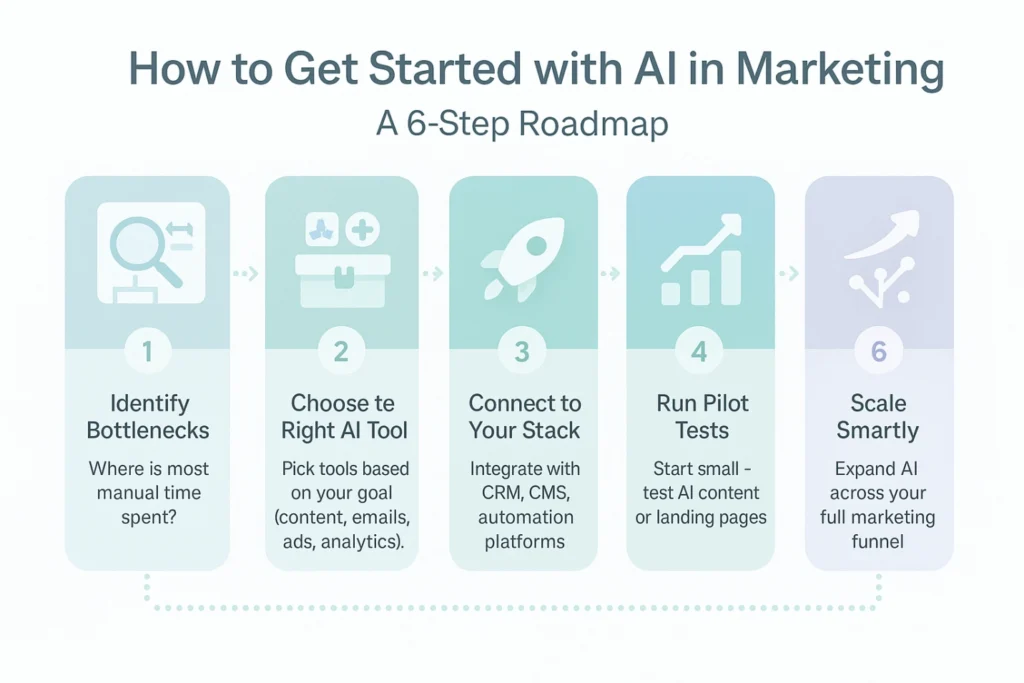
AI in marketing may sound complex, but getting started doesn’t have to be. Here’s a simple roadmap that businesses of any size can follow:
Step 1: Identify Your Bottlenecks
Start by asking: where is your team spending the most manual time? Common areas include content creation, customer support, lead nurturing, or email marketing.
Step 2: Choose the Right AI Tool
No one tool does it all. Pick AI platforms based on your specific goals:
- Content → Jasper, ChatGPT, Copy.ai
- Emails → Rasa.io, Seventh Sense
- Ads → Smartly.io, Meta Advantage+
- Analytics → Salesforce Einstein, Zoho Zia
Step 3: Connect to Your Stack
Most AI tools integrate easily with your CMS, CRM, and marketing automation platforms. This makes implementation smoother and reduces friction.
Step 4: Run Pilot Tests
Start with a single channel or campaign. For example, test AI-generated product descriptions or run an AI-powered A/B test on your top landing page.
Step 5: Monitor and Optimize
Track metrics like CTR, conversion rate, and cost-per-lead. AI tools learn fast, but they improve even faster with human input.
Step 6: Scale Smartly
Once you see success in one area, expand AI to other parts of your marketing funnel — and integrate across departments for compounding gains.
5 Common AI Marketing Mistakes to Avoid
AI is powerful but it’s no plug-and-play magic! Steering clear of these 5 common mistakes will help you preserve your wallet and maintain your brand voice.
1. Using AI without clean data
When your existing data is stale, duplicated, and/or mixed together with outdated stuff, you can expect your AI outputs, and reports, to be erroneous and misleading.
2. Depending on AI without strategy
AI should amplify your strategy, not define it. Presumably, you have a brand voice, customer personas, and a buyer journey defined.
3. Over-automating interactions with customers
Find the balance between automation and in-person authenticity. It is okay to use chatbots and email flows in specific areas of your business, but always have a human option as your fail-safe.
4. Not considering compliance & ethical practices
AI tools should be compliant with privacy regulations (GDPR, CCPA), and avoid patterns of discrimination. Audit yourself routinely, and remain transparent with customers.
5. Not providing your staff with proper training
Your tools can only be as beneficial as the personnel who use them. Train your staff to use AI not only technically, but creatively.
Top AI Marketing Tools for 2025–2026
These AI-powered tools are leading the way in transforming how modern marketers operate:
| Category | Tool(s) | Use Case Example |
| Content Generation | Jasper, Copy.ai, ChatGPT | Write blogs, social posts, landing page copy |
| Video Creation | Synthesia, RunwayML, Pictory | AI avatars, explainer videos, short-form reels |
| Email Personalization | Rasa.io, Seventh Sense | Dynamic content and send-time optimization |
| Website Personalization | Dynamic Yield, Mutiny | Custom banners, pop-ups, and product suggestions |
| Ad Optimization | Smartly.io, Meta Advantage+ | Automated creatives, real-time budget shifts |
| Social Listening | Brandwatch, Sprinklr | Sentiment analysis, competitor tracking |
| Predictive Analytics | Salesforce Einstein, Zoho Zia | Lead scoring, sales forecasting |
Each tool excels in a niche — the real power lies in how you stack them together.
What’s Next: The Future of AI in Marketing (2026 and Beyond)
We are just starting to realize what AI will mean for marketers over the next few years. With that said, here is a sneak peek of what’s to come:
• Autonomous Marketing Agents
Two types of AI agents (one for planning, one for delivering) that plan, create, deploy, and optimize campaigns — start-to-finish — with zero human intervention.
• Emotion Recognition
AI that will tailor ads to a user’s facial expression, tone of voice, or biometric response.
• Neuromarketing + AI
Combining EEG headsets and eye-tracking capability with AI will predict ad resonance and user sentiment before a campaign is even launched.
• Blockchain-Backed AI Campaigns
Decentralized AI to prevent ad fraud, transparency in influencers and verified data sourcing.
• Hyper-Personalized Omnichannel Journeys
Personalization will extend to every customer touchpoint (email, ad, app, chatbot) and will adapt in real-time to micro-moments and behavioral triggers.
Those marketers who embrace these shifts early will be the category leaders of tomorrow.
Which AI Tactic is Right for You?
With so many use cases, it’s easy to feel overwhelmed. Here’s a cheat sheet based on your business type:
| Business Type | Recommended Starting Point |
| Startup | AI content creation (blogs, landing pages) + chatbots for FAQs |
| D2C Brand | Product recommendation engines + smart email flows |
| B2B SaaS | Predictive lead scoring + smart CRMs like Salesforce Einstein |
| Enterprise | Full-stack AI personalization + media buying automation |
| Marketing Agencies | AI copywriting tools + A/B testing + AI-powered design/video tools |
Choose your path based on ROI potential + ease of integration, then expand from there.
Brandlogg: A Trusted Leader in AI-Powered Marketing
At Brandlogg, we believe that AI isn’t replacing marketers—it’s empowering them.
As one of India’s most forward-thinking branding and marketing agency, we’ve embraced artificial intelligence not just as a tool, but as a core part of our strategy.
We help clients:
- Run hyper-personalized campaigns using AI insights
- Automate branding audits and creative testing
- Generate hundreds of content and ad variations instantly
- Predict customer behavior for smarter growth planning
Whether you’re a startup looking to scale or an enterprise seeking marketing transformation — Brandlogg is your AI-powered partner for results that matter.
Final Thoughts: Marketing’s Future Has Already Arrived
AI isn’t optional anymore. It’s the difference between growth and stagnation, personalization and irrelevance, success and struggle.
The 15 examples above prove one thing: AI is already delivering powerful ROI across the world’s biggest brands.
If you’re not using it, your competitors already are.
Key Takeaways:
- Start small: content, email, or ads
- Ensure your data is clean and structured
- Pair AI with human creativity for exponential results
Ready to transform your marketing with AI?
Let Brandlogg guide the way.
What It Is:
What It Is: